









What's Happening?
Hawaii's tourism sector experienced a significant downturn in September due to the impact of back-to-back tropical weather systems, Hurricane Lowell and Hurricane Nolo. Preliminary data from the Department of Business, Economic Development and Tourism
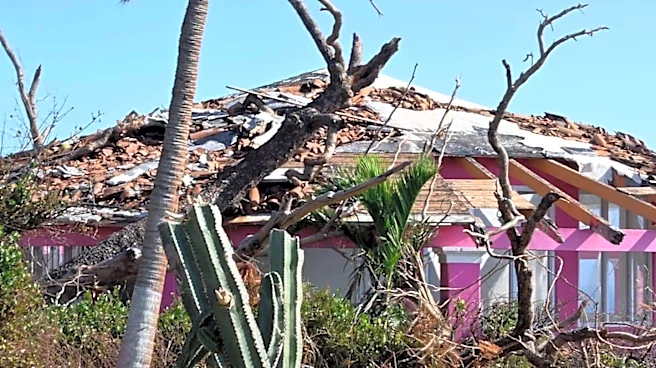
(DBEDT) indicates that total visitor spending dropped by 9% to $1.41 billion, a decrease of approximately $140 million compared to the same period last year. Visitor arrivals also fell by 3.6% to 672,990. Hurricane Lowell, which skirted the islands in early September, caused widespread flight disruptions, port closures, and damage, followed by outer rainbands from Hurricane Nolo. This led to shorter visitor stays, with the average length of stay decreasing from 8.25 days to 7.39 days. Jennifer Chun, DBEDT’s director of tourism research, noted that all major markets, including U.S. West, U.S. East, Japan, and Canada, saw declines in visitor numbers and expenditures.
Why It's Important?
The decline in tourism has created a significant ripple effect across Hawaii's local economy, particularly impacting the restaurant industry. Sheryl Matsuoka, CEO of the Hawaii Restaurant Association, reported that dining establishments are experiencing sales plunges of 20% to 30%, some of the lowest figures since the pandemic. This reduction in sales directly affects local farmers, suppliers, and distributors, as restaurants decrease their orders. Furthermore, the reduced customer volume is leading to cuts in workers' hours, with many employees seeing their workweeks reduced from 40 to 30 hours, particularly in smaller, independently owned businesses. Kauai was particularly hard hit, with visitor arrivals plummeting 35% and spending dropping 44.3% after Hurricane Lowell shut down Nawiliwili Harbor and disrupted air travel. The state is offering emergency relief through the Small Business Recovery Grant Program, providing $5,000 to $10,000 grants to storm-impacted small businesses and nonprofits.
What's Next?
While September presented a significant setback, Hawaii's broader tourism outlook for the year remains positive, with year-to-date visitor spending through the first nine months of 2026 reaching $16.62 billion, a 2.8% increase over the same period in 2025. However, the immediate future will likely see continued efforts to mitigate the impact of the September storms on local businesses. The Small Business Recovery Grant Program, administered by the Chamber of Commerce Hawaii, will continue to provide financial assistance to affected small businesses and nonprofits. State researchers also highlight ongoing challenges beyond storm disruptions, such as inflation and rising airfares, which are impacting household travel budgets. These factors may continue to influence visitor spending on the islands, even as Hawaii remains a desirable destination. The tourism sector will need to monitor these economic pressures alongside potential future weather events.
Beyond the Headlines
The vulnerability of Hawaii's tourism-dependent economy to natural disasters like hurricanes is a recurring theme, highlighting the need for robust disaster preparedness and economic diversification strategies. The immediate impact on small businesses and their employees underscores the fragility of local economies heavily reliant on a single industry. The 'trickle-down effect' described by the Hawaii Restaurant Association CEO illustrates how disruptions at the consumer level quickly propagate through the entire supply chain, affecting farmers, distributors, and ultimately, the livelihoods of many residents. This situation also brings to light the broader economic pressures of inflation and rising travel costs, which can diminish the spending power of tourists even when they do visit. The state's response through grant programs is crucial for short-term recovery, but long-term resilience may require exploring ways to buffer the economy against both environmental shocks and broader economic trends.