






What's Happening?
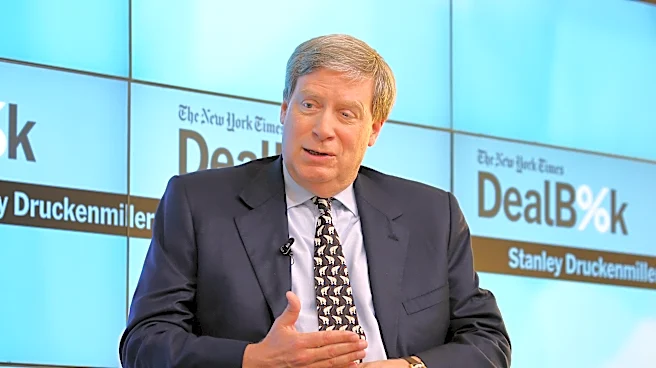
Stanley Druckenmiller's family office filed its third-quarter 13F, revealing a significant reduction in its portfolio. The number of positions decreased from 95 to 65, with the total value shrinking to $4.47 billion by September 30. Druckenmiller expressed
caution regarding market clarity for the next 12 months, stating his firm is prioritizing capital preservation over aggressive growth. He has largely stepped back from major directional bets, maintaining a net equity exposure that is roughly flat. Despite this defensive stance, he has increased his stake in an online retail and cloud giant by approximately 43% and nearly tripled his position in a hard disk drive manufacturer. His largest holding remains a cancer-recurrence blood test maker, valued at $1.31 billion.
Why It's Important?
Druckenmiller's cautious approach and portfolio adjustments are significant indicators for the U.S. financial markets, particularly for investors tracking influential hedge fund managers. His move to reduce exposure and focus on capital preservation suggests a broader sentiment of uncertainty among some seasoned investors regarding the market's near-term direction. His prediction about the shift in AI opportunities, from infrastructure building to AI-driven services like cybersecurity, highlights a potential re-evaluation of investment strategies within the rapidly evolving AI sector. This could influence other investors to consider companies that leverage AI for practical business applications rather than solely those involved in hardware or data center development. The emphasis on cybersecurity as a key area for AI application underscores the growing importance of digital defense in the business landscape.
What's Next?
Druckenmiller's outlook suggests that investors may increasingly scrutinize the profitability and practical applications of AI technologies. The focus on AI labs potentially transitioning from selling model access to offering finished work, such as software development and cybersecurity investigations, could lead to a re-rating of companies in these sectors. Established security companies might face new competitive pressures from AI agents deployed by these labs. The market will likely observe how these AI labs evolve their business models and whether they can effectively compete with existing cybersecurity firms. This shift could also spur further innovation in AI-driven cybersecurity solutions, as companies vie for market share in this emerging segment.
Beyond the Headlines
Druckenmiller's insights extend beyond mere stock picks, touching upon the fundamental evolution of the AI industry. His vision of AI labs fielding 'swarms of AI agents' to defend businesses against attacks points to a future where AI plays a more autonomous and proactive role in critical business functions. This raises profound questions about the nature of work, the future of human-AI collaboration, and the potential for AI to disrupt traditional service industries. The ethical implications of AI agents operating with significant autonomy, particularly in sensitive areas like cybersecurity, will also become a critical discussion point. This perspective suggests a long-term shift in how businesses approach technology adoption and risk management, with AI becoming an indispensable, rather than merely supplementary, tool.