





What's Happening?
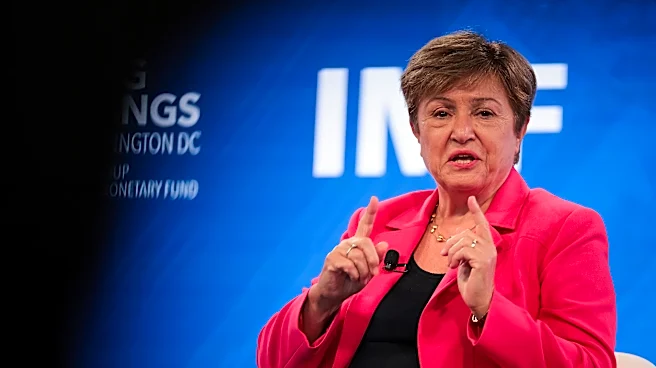
Gita Gopinath, a Harvard professor and former chief economist of the IMF, has articulated a significant concern regarding the global economy's current stability. She posits that the world economy is being held together by a substantial AI investment boom,
which is currently offsetting the negative impacts of tariffs and geopolitical tensions. Gopinath warns that a correction in AI valuations, which she expects to occur, would likely trigger a recession in the United States. She highlights that approximately $1 trillion is being invested globally in AI in 2026 alone, and it is unclear how companies will generate sufficient profits to recover this capital. This situation creates a 'great gamble' where two opposing forces—the AI supercycle and geopolitical instability—are currently canceling each other out, creating a deceptive surface calm in global growth projections. The US economy, in particular, is experiencing a lift from AI, masking other economic drags.
Why It's Important?
The potential for an AI valuation correction to induce a US recession carries significant implications for global financial markets and economic stability. Gopinath's analysis suggests that the current economic equilibrium is fragile, heavily reliant on the sustained growth of the AI sector. A downturn in AI investments could expose underlying vulnerabilities, including the impact of tariffs and geopolitical conflicts, which are currently being masked. The interconnectedness of the financial system, with large investment firms operating outside traditional bank regulations and significant circular financing within the AI industry, raises concerns about potential contagion similar to the 2008 financial crisis. A US recession would not only affect American households and businesses through job losses and reduced spending but also transmit higher interest rates globally, impacting countries reliant on US borrowing as a foundation for their own rates.
What's Next?
While Gopinath does not provide a timeline for an AI valuation correction, she emphasizes that the current period is a critical window for governments to address rising debt levels. She suggests that without responsible spending and potential financial repression, another major crisis could force fresh spending surges, exacerbating the debt problem. The future trajectory of the US economy will depend on whether the AI sector can deliver a sustained productivity boom and if governments can implement prudent fiscal policies. Additionally, the independence of the Federal Reserve and the stability of the 10-year Treasury yield will be crucial indicators to monitor. The ongoing debate about AI safety and the lack of international coordination on this front also represent significant, unresolved risks that could impact the industry's future.
Beyond the Headlines
Gopinath's insights extend beyond immediate economic forecasts, touching upon deeper structural issues and ethical considerations. Her warning about 'cognitive surrender' in the age of AI highlights a critical societal challenge: the risk of individuals outsourcing critical thinking before the technology is adequately mature. This has implications for education, skill development, and the very nature of expertise. The discussion also underscores the persistent challenges faced by emerging economies like India in attracting global supply chain investments due to long-standing domestic bottlenecks such as judicial processes and ease of doing business. Furthermore, the analysis of the dollar's continued dominance, despite narratives of a changing world order, reveals the inertia and liquidity advantages that maintain its status as a global safe haven, contingent on the Federal Reserve's independence and US fiscal responsibility.