






What's Happening?
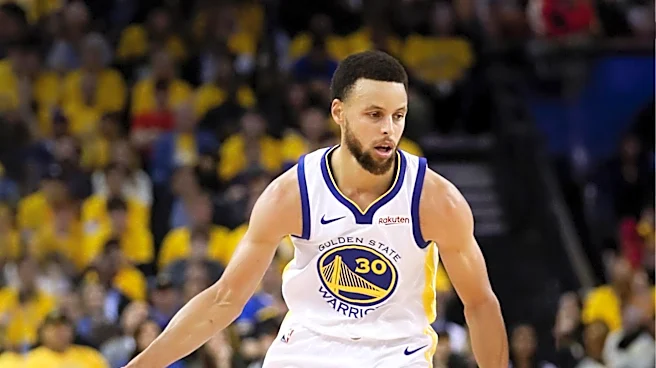
Stephen Curry, point guard for the Golden State Warriors, has signed a two-year, $116 million contract extension. This new deal, reported by ESPN's Shams Charania, makes Curry the highest on-court earner in NBA history, with his career earnings projected
to reach $652 million. Notably, Curry accepted a $20 million pay cut as part of this extension, a move intended to provide the Warriors with greater financial flexibility for future roster adjustments. The 38-year-old Curry has a distinguished career, including four NBA titles, one Finals MVP, two regular season MVPs, 12 All-Star selections, and 11 All-NBA team honors. The Warriors presented Curry with various contract options, including max deals and discounted salaries, with Curry ultimately opting for the team-friendly approach to aid in building a stronger roster.
Why It's Important?
This contract extension for Stephen Curry is significant for several reasons, both for the Golden State Warriors and the broader NBA. For the Warriors, Curry's decision to take a pay cut demonstrates a commitment to team success over individual financial maximization, potentially allowing the franchise to acquire key free agents in the 2027 offseason. With up to $64 million in cap space potentially available, the team's management will have a crucial opportunity to build a competitive roster around their star player. For the NBA, Curry's record-breaking career earnings highlight the increasing financial scale of professional basketball and the value placed on elite talent. His willingness to prioritize team flexibility could also set a precedent for other veteran stars, influencing future contract negotiations across the league and potentially fostering a more collaborative approach between star players and their franchises.
What's Next?
Following Stephen Curry's contract extension, the immediate focus for the Golden State Warriors will be on leveraging the newfound cap flexibility. The team's management will now be tasked with strategically utilizing the additional $64 million in cap space, particularly in the 2027 offseason, to attract and sign high-caliber free agents. This period will be critical for assembling a roster capable of competing for future championships alongside Curry. The decision to take a pay cut by a player of Curry's stature could also influence upcoming contract negotiations for other star players in the league, potentially leading to more team-friendly deals as players prioritize championship contention. Fans and analysts will closely watch the Warriors' moves in the coming seasons to see how this strategic financial decision impacts their on-court performance and long-term competitiveness.
Beyond the Headlines
Stephen Curry's contract decision extends beyond mere financial figures, touching upon the evolving dynamics between star athletes and their franchises in professional sports. His choice to accept a pay cut, despite being eligible for a larger sum, underscores a growing trend where established, successful players prioritize team legacy and championship aspirations over individual maximum earnings. This move could foster a culture of collective responsibility within the Warriors organization and potentially inspire other veteran players across the NBA to consider similar sacrifices for the greater good of their teams. It also highlights the increasing influence of player leadership in shaping team strategy and roster construction. The long-term implications could include a shift in how player loyalty and financial incentives are balanced, potentially leading to more stable and competitive team compositions in an era often dominated by player movement and super-teams.