







What's Happening?
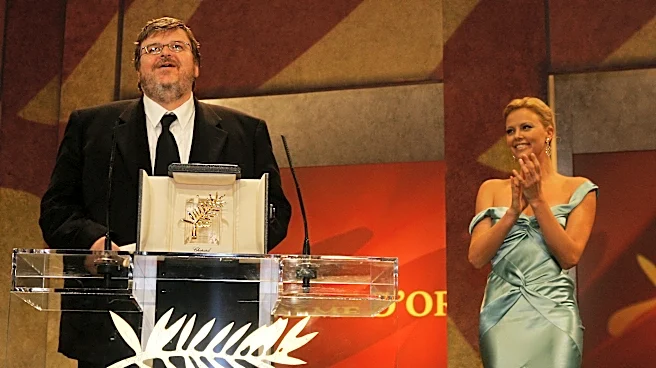
In 2004, Michael Moore's documentary 'Fahrenheit 9/11' achieved significant recognition by winning the Palme d'Or at the Cannes Film Festival. The jury, led by Quentin Tarantino, awarded the film, which subsequently grossed hundreds of millions of dollars
and broke box office records for documentaries. Despite its critical and commercial success, the film did not prevent George W. Bush from securing a second term as president. Years later, Tarantino retrospectively commented that 'Fahrenheit 9/11' was a 'movie of the moment,' suggesting that Park Chan-wook's 'Oldboy' might have been a more deserving recipient of the Palme d'Or. This highlights the subjective and often time-sensitive nature of film awards, particularly at festivals like Cannes, where juries are newly formed each year and make decisions based on immediate impact and artistic merit.
Why It's Important?
The success of 'Fahrenheit 9/11' underscored the potential for documentary films to achieve mainstream commercial success and exert significant cultural influence. Its Palme d'Or win elevated Michael Moore's status as a prominent filmmaker and demonstrated that politically charged documentaries could resonate with a broad audience. The film's financial performance challenged conventional wisdom about the commercial viability of non-fiction cinema, paving the way for future documentaries to secure wider distribution and larger budgets. However, Tarantino's later remarks about the film being a 'movie of the moment' also raise important questions about the enduring artistic value versus immediate political relevance of award-winning films. This distinction is crucial for understanding how film festivals balance artistic innovation with social commentary, and how these decisions can shape public discourse and the trajectory of filmmakers' careers.
What's Next?
The legacy of 'Fahrenheit 9/11' continues to influence documentary filmmaking, encouraging creators to tackle complex political and social issues with a bold, often confrontational, style. Future documentary filmmakers may draw inspiration from Moore's approach to blend investigative journalism with personal narrative, aiming for both critical acclaim and commercial success. The debate over whether a film's immediate political impact or its timeless artistic quality should be prioritized in awards decisions will likely persist within film circles. This ongoing discussion could lead to evolving criteria for film festival juries and a greater emphasis on films that offer both profound social commentary and lasting artistic merit. The film's success also set a precedent for how politically charged content can be marketed and distributed, potentially influencing strategies for future issue-driven media.
Beyond the Headlines
Beyond its immediate impact, 'Fahrenheit 9/11' contributed to a broader cultural shift in how audiences perceive and engage with non-fiction storytelling. It blurred the lines between journalism, activism, and entertainment, prompting discussions about objectivity and the filmmaker's role in shaping public opinion. The film's success also highlighted the power of cinema as a tool for political discourse, demonstrating its capacity to challenge established narratives and provoke critical thought. The controversy surrounding its political stance and its reception at Cannes reflected deeper societal divisions and the ongoing struggle to reconcile artistic expression with political agendas. This development has long-term implications for media literacy, encouraging audiences to critically evaluate the perspectives presented in documentaries and to consider the various factors that contribute to a film's critical and commercial success.