





What's Happening?
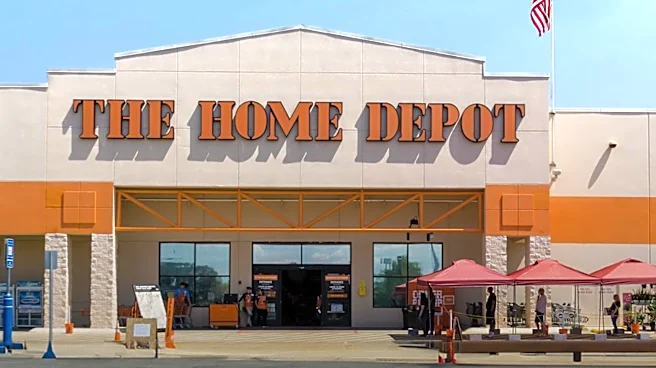
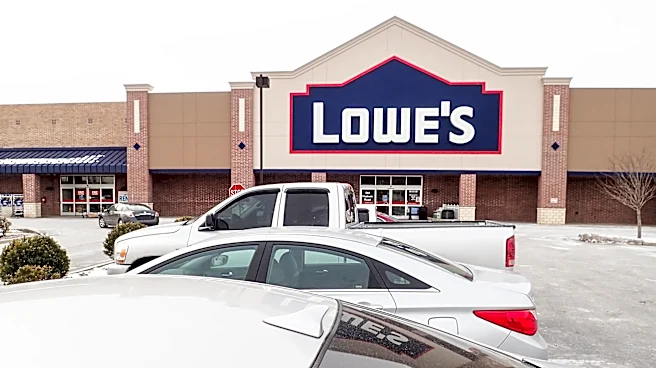
Home Depot demonstrated stronger performance compared to Lowe's in their fiscal third-quarter earnings, despite a difficult housing market and elevated interest rates. Home Depot reported better comparable sales growth of 2.2% against Lowe's 1.8%, and significantly
higher revenue at $43.4 billion compared to Lowe's $22.8 billion. Home Depot also showed superior earnings-per-share growth of 3.2% versus Lowe's 1.3%, and a stronger operating margin of 12.6% compared to 11.3%. While both companies saw positive comparable sales from professional customers, Home Depot's greater focus on this segment is cited as a key differentiator. Home Depot also announced leadership changes, with CFO Richard McPhail succeeding Ted Decker as CEO, and Jordan Broggi becoming the new executive vice president and CFO. Ann-Marie Campbell will take over as president and COO.
Why It's Important?
The differing performances of Home Depot and Lowe's highlight the impact of strategic focus on professional customers in a challenging economic environment. Home Depot's emphasis on the professional segment provides a more stable revenue stream, which is crucial when the broader housing market is constrained by high mortgage rates. This strategy positions Home Depot more favorably for future recovery. The leadership changes at Home Depot, particularly the new CEO, could signal a continuation or reinforcement of this pro-customer strategy, aiming for sustained growth. For investors, this comparison suggests that Home Depot might be a more resilient investment in the current market conditions, offering a more durable business model until housing activity rebounds.
What's Next?
The home improvement sector will continue to face headwinds from elevated mortgage rates and a stagnant housing market. Both Home Depot and Lowe's will need to adapt their strategies to navigate this environment. Home Depot's new leadership team will likely focus on maintaining and expanding its advantage in the professional customer segment. Analysts suggest that Home Depot is well-positioned for when interest rates eventually decline and the housing market recovers. The company's stock is anticipated to see significant gains once these macroeconomic conditions improve. Lowe's, while showing some improvement, may need to further enhance its professional customer offerings to close the gap with Home Depot.
Beyond the Headlines
The divergence in performance between Home Depot and Lowe's underscores a broader trend in retail where specialized customer segments can offer greater stability than general consumer markets during economic downturns. The 'pro' customer, often involved in larger, more consistent projects, provides a more predictable revenue stream compared to the more discretionary spending of 'do-it-yourself' customers. This shift highlights the importance of targeted business strategies and supply chain efficiency in competitive markets. The acquisitions made by Home Depot in specialty building products years ago demonstrate foresight in securing this professional market, a move Lowe's has been playing catch-up on. This strategic difference could have long-term implications for market share and profitability in the home improvement industry.