

What's Happening?
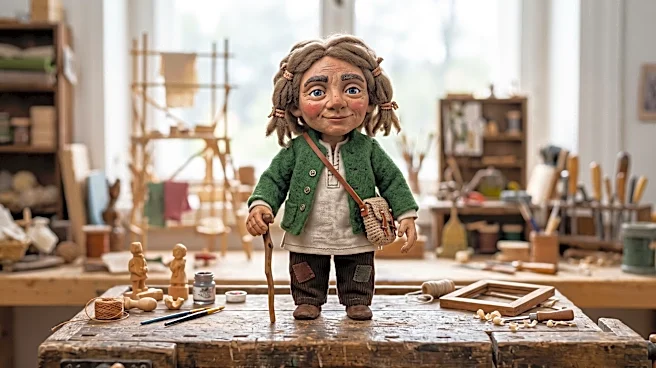
Travis Knight, director of Laika Studios' latest stop-motion film 'Wildwood,' is championing traditional, handcrafted animation in an era increasingly influenced by artificial intelligence. 'Wildwood,' which utilizes 233 puppets and 142,030 interchangeable
facial expressions across 132 hand-built sets, is being positioned as a defiant counterpoint to AI-generated content. Knight, who is also Laika's CEO and co-founder, emphasizes the human element in stop-motion, describing it as an 'incredibly laborious, painstaking, tedious, horrible way to make a movie,' but ultimately a 'very human way.' The film, released in October, follows a teen girl named Prue on a quest to find her kidnapped brother in an enchanted forest. Despite its artistic ambition and Oscar buzz, 'Wildwood' faces significant financial stakes, with an estimated budget of $100 million before marketing, having generated approximately $80 million globally so far. Knight acknowledges the industry's shift towards cheaper technology but maintains that AI and stop-motion should not creatively blend, asserting that human connection is vital to storytelling.
Why It's Important?
This stance by Travis Knight and Laika Studios highlights a critical debate within the U.S. entertainment industry regarding the role of artificial intelligence in creative processes. As AI tools become more sophisticated and accessible, they offer potential cost savings and efficiency, which could significantly impact animation studios and their production models. Laika's commitment to stop-motion, a time-consuming and expensive art form, represents a resistance to this technological tide, emphasizing the value of human artistry and craftsmanship. The commercial performance of 'Wildwood' will be a key indicator of audience appetite for handcrafted animation versus AI-assisted or fully AI-generated content. If 'Wildwood' achieves significant success, it could bolster arguments for preserving traditional animation techniques and encourage other studios to invest in human-centric creative endeavors. Conversely, if it struggles, it might reinforce the industry's lean towards more cost-effective, technology-driven production methods, potentially leading to fewer opportunities for traditional animators and a shift in the aesthetic landscape of animated films.
What's Next?
The immediate future for 'Wildwood' involves its continued performance at the box office and its reception during awards season, particularly with its Oscar buzz for best animated feature. A strong showing could provide Laika Studios with the financial and critical leverage to continue its unique approach to filmmaking. Beyond this film, Laika is already diversifying its portfolio by producing its first live-action film in collaboration with Emma Stone's production company, indicating a strategic move to broaden its creative output while maintaining its core identity. The broader industry will likely continue to grapple with the integration of AI, with ongoing discussions about ethical implications, job displacement, and the definition of artistic authenticity. The success or struggle of films like 'Wildwood' will serve as case studies for other studios and filmmakers as they navigate the evolving technological landscape, influencing future investment in traditional versus AI-driven animation techniques. The debate over whether audiences 'feel the difference' between human-made and AI-generated art will continue to shape creative decisions.
Beyond the Headlines
The narrative surrounding 'Wildwood' and Laika's anti-AI stance delves into deeper philosophical questions about the nature of art and human creativity in the age of advanced technology. Knight's assertion that 'a computer has never fallen in love, a computer has never had its heart broken' speaks to the belief that genuine emotional resonance in art stems from human experience, which AI can only approximate. This raises ethical considerations about the authenticity of art and the potential for AI to devalue human artistic contributions. The long-term implications could include a bifurcation of the animation industry: one segment embracing AI for efficiency and scale, and another preserving traditional methods for their unique artistic and emotional qualities. This could lead to a niche market for handcrafted films, valued for their 'soul' and human touch, while mainstream productions might increasingly leverage AI. Ultimately, the cultural impact could be a re-evaluation of what constitutes 'art' and 'artist' in a world where machines can generate creative outputs, prompting audiences and creators alike to consider the intrinsic value of human effort and emotion in storytelling.