


What's Happening?
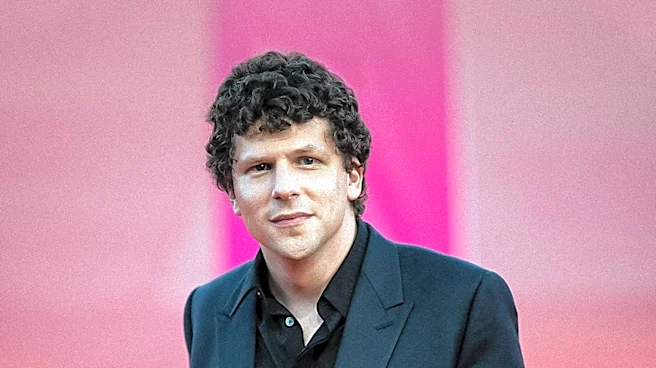
Jesse Eisenberg, known for his acting, writing, and directing, has voiced significant concerns regarding the potential of artificial intelligence to replace human creative roles in Hollywood. In an interview with Variety, alongside his 'The Debut' co-star
Julianne Moore, Eisenberg admitted to being 'totally paranoid' about AI's advancements. This paranoia has led him to personally experiment with AI writing tools, prompting them to generate scenes to assess their current capabilities. He reported that, as of now, AI's writing quality remains subpar, providing him with temporary relief. Eisenberg's new A24 film, 'The Debut,' which he wrote, directed, and stars in, is inspired by his experiences in community theater and features Julianne Moore and Paul Giamatti. The film centers on a housewife who secures a minor role in a community musical. The discussion around AI's role in the entertainment industry has been a contentious topic among creatives, with varying opinions ranging from strong opposition to cautious optimism.
Why It's Important?
Eisenberg's public statements highlight a growing anxiety within the creative community about AI's encroaching presence in industries traditionally reliant on human ingenuity. His direct engagement with AI tools to test their efficacy underscores a practical, albeit anxious, approach to understanding the threat. This sentiment is particularly relevant in Hollywood, where recent labor disputes have included AI usage as a key point of contention. If AI were to achieve sophisticated writing capabilities, it could drastically alter the landscape for screenwriters, playwrights, and other content creators, potentially leading to job displacement and a shift in how creative projects are conceived and executed. The debate also touches upon the perceived value of human-made art versus AI-generated content, with some audiences reportedly seeking out human-created works amidst the rise of AI-produced material. Eisenberg's concerns reflect a broader societal discussion about the future of work and creativity in an increasingly automated world.
What's Next?
The ongoing debate about AI's role in Hollywood is expected to intensify as the technology continues to evolve. While Eisenberg currently finds AI's writing capabilities lacking, the rapid pace of AI development suggests that this assessment could change. Future discussions will likely focus on establishing ethical guidelines and regulatory frameworks for AI use in creative industries, potentially involving further negotiations between studios, unions, and artists. The entertainment industry may see continued experimentation with AI for various tasks, from script development to post-production, prompting creatives to adapt their skills or advocate for protections against AI displacement. The reception of films like 'The Debut,' which are deeply rooted in human experience and creativity, could also serve as a barometer for audience preference in an era where AI-generated content becomes more prevalent. The industry will need to navigate the balance between technological advancement and preserving human artistic expression.
Beyond the Headlines
Eisenberg's 'paranoid' experimentation with AI delves into deeper philosophical questions about the nature of creativity and the unique value of human storytelling. His fear that a child could one day generate a personalized movie experience with a pair of goggles touches upon the potential for AI to democratize content creation to an extreme degree, but also to dilute the shared cultural experience of art. This raises ethical considerations about authorship, originality, and the emotional resonance of stories crafted by algorithms versus those born from human experience. The long-term implications could include a redefinition of what constitutes 'art' and 'artist,' as well as a shift in how audiences consume media. If AI can perfectly mimic human creativity, it challenges our understanding of consciousness and the human spirit's role in artistic expression. This technological shift could also lead to a greater appreciation for authentic, human-made content, creating a niche market for art that explicitly emphasizes its human origin.