






What's Happening?
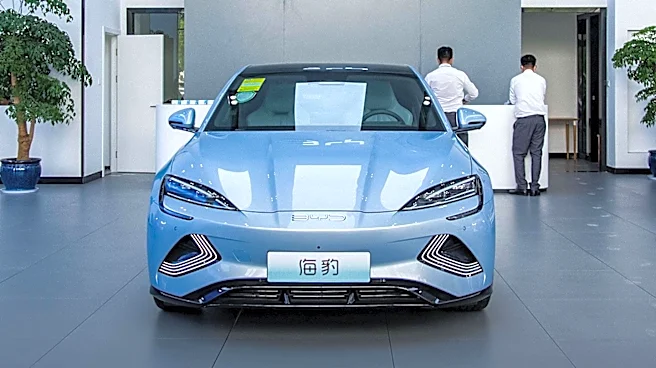
Chinese carmaker BYD is exploring the possibility of establishing an electric vehicle battery plant in Portugal. The former Galp refinery site in Matosinhos is among the locations under consideration. This potential investment aims to strengthen Portugal's
position within the Iberian electric mobility supply chain. Discussions have reportedly taken place between BYD, the Portuguese government, and AICEP, the country's trade and investment agency. Matosinhos mayor Luísa Salgueiro has expressed a welcoming stance towards such an investment, although formal contact with the municipality is pending. The proposed site offers strategic advantages, including proximity to the future Barroso lithium mine, expected to commence production in 2028, and access to the port of Leixões and major transportation networks. This plant could potentially serve as a regional battery production hub, supporting BYD's anticipated car factory in Spain.
Why It's Important?
While this development is focused on Europe, it highlights the global race for electric vehicle battery production capacity and the strategic importance of securing raw material supply chains. For the U.S., this signifies the intensifying international competition in the EV sector. As global automakers, including those with significant U.S. market presence, increasingly localize battery production, it could influence investment decisions and supply chain strategies for EV manufacturers operating in or supplying to the U.S. market. The establishment of such a plant in Europe could also impact the availability and pricing of EV components globally, potentially affecting U.S. consumers and manufacturers. The move underscores the broader trend of countries and regions vying to become key players in the burgeoning electric vehicle ecosystem, driven by both economic and environmental considerations.
What's Next?
The Portuguese Economy Ministry and AICEP are actively supporting the project, with Economy Minister Castro Almeida acknowledging ongoing 'fruitful dialogue' with a Chinese carmaker regarding a potential unit in Portugal. Further details are expected as negotiations progress. If the plant materializes, it would likely lead to significant job creation and economic development in the Matosinhos region. The project's success could also encourage other international EV and battery manufacturers to consider similar investments in Europe, further solidifying the continent's role in the global EV supply chain. The integration with the Barroso lithium mine and a potential car factory in Spain suggests a comprehensive regional strategy by BYD.
Beyond the Headlines
This potential investment by BYD in Portugal reflects a broader geopolitical and economic trend: the decentralization of critical manufacturing capabilities, particularly in the electric vehicle sector. As nations prioritize energy independence and reduce reliance on single-source supply chains, the establishment of regional production hubs for EV batteries becomes crucial. This move could also be seen as a strategic play by BYD to mitigate potential trade barriers or supply chain disruptions by diversifying its manufacturing footprint outside of China. For the U.S., this emphasizes the need for robust domestic policies and incentives to attract and retain EV battery manufacturing, ensuring national economic security and technological leadership in the face of global competition.