





What's Happening?
Matt Brill, Head of North America Investment-Grade Credit and Senior Portfolio Manager at Invesco, provided an in-depth analysis of the U.S. economy, focusing on the impact of artificial intelligence (AI) spending and the current state of fixed income
markets. Brill highlighted that the Federal Reserve's dual mandate of labor markets and inflation is currently influenced by a tight job market (4.2%-4.3% unemployment) and persistent inflation, partly due to elevated commodity prices and the significant capital expenditure (CapEx) associated with AI build-out. He noted that while the near-term AI build-out is inflationary, the long-term effects are expected to be deflationary due to productivity gains. The discussion also touched upon the 'K-shaped economy,' where the top income bracket benefits from asset ownership and AI advancements, while the lower bracket, despite some struggles, is supported by a strong labor market. Brill emphasized the robust health of corporate balance sheets, with strong earnings and a low rate of companies downgrading from investment-grade to high-yield status.
Why It's Important?
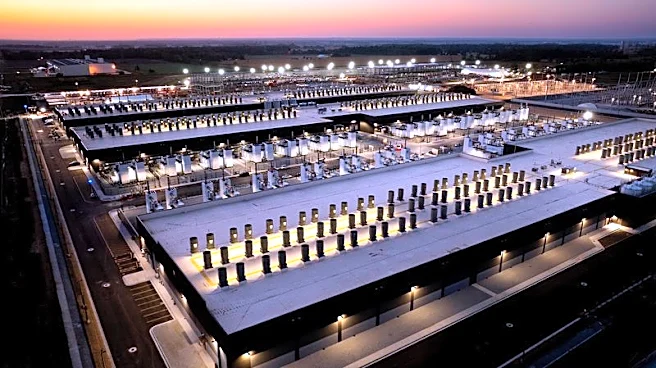
This analysis is crucial for U.S. investors and policymakers as it outlines the complex interplay between technological advancement, economic growth, and monetary policy. The substantial investment in AI by 'hyperscalers' (Alphabet, Amazon, Meta, Microsoft, Oracle) is not only driving economic activity but also creating inflationary pressures and influencing credit markets. The assessment of corporate balance sheet strength provides a positive outlook for credit investments, suggesting a stable environment despite market volatility. Understanding the 'K-shaped economy' is vital for addressing wealth disparity and ensuring equitable economic benefits. Furthermore, the distinction between equity and fixed income market concentrations regarding AI-related debt highlights different risk profiles for investors, with fixed income offering greater diversification compared to the more concentrated equity indices. This perspective helps investors make informed decisions about asset allocation and risk management in a rapidly evolving economic landscape.
What's Next?
Invesco anticipates continued strong economic performance driven by AI build-out, projecting a multi-year cycle of growth. However, the firm is tactically reducing risk in its portfolios due to tight spreads in the credit markets, aiming to build 'dry powder' to capitalize on potential buying opportunities, particularly after Labor Day when large investment-grade deals are common. The upcoming midterm elections are expected to introduce some volatility, with key areas of focus being potential policy changes regarding the budget deficit and the future of data center construction. These political decisions could significantly impact capital markets and CapEx spending. The ongoing demand for power and industrial infrastructure due to AI development suggests continued growth for utilities and industrial sectors. Investors will need to monitor the balance between inflationary pressures from AI build-out and the long-term deflationary impact of increased productivity, as this will influence the Federal Reserve's future interest rate decisions.
Beyond the Headlines
The discussion reveals a deeper narrative about the structural transformation of the U.S. economy driven by AI. Beyond immediate financial metrics, the 'hyperscaler' phenomenon is reshaping entire industries, from banking and utilities to classic industrials, by creating new demand for infrastructure and services. This massive capital deployment signifies a fundamental shift in how economic growth is generated and sustained. The long-term implications include potential for significant productivity gains across all sectors, which could redefine labor markets and corporate profitability. However, it also raises questions about the equitable distribution of these benefits, as highlighted by the 'K-shaped economy' observation. The political dimension, particularly concerning data center development, underscores the growing societal and environmental considerations tied to technological advancement. This era of AI-driven growth presents both immense opportunities and complex challenges, requiring continuous adaptation from businesses, investors, and policymakers to navigate its multifaceted impact.