








What's Happening?
Researchers at the Helmholtz Centre for Environmental Research (UFZ), in collaboration with BOKU University in Vienna, have developed a novel process that converts carbon dioxide (CO2) into itaconic acid, a key chemical used in biodegradable plastics.
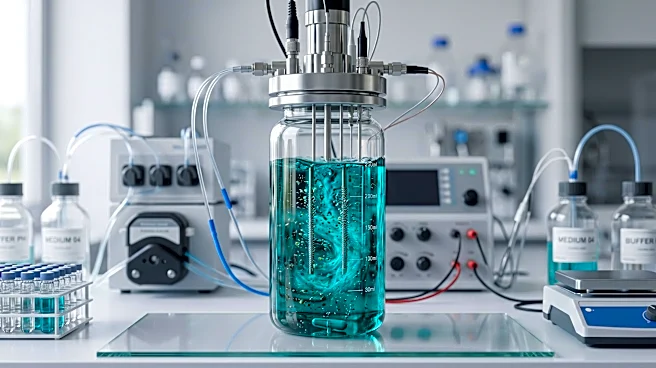
This innovative method combines electrochemical and microbial processes within a single electrobioreactor. Traditionally, itaconic acid is produced biotechnologically from sugar using a fungus. However, this new approach utilizes CO2 as a starting material, aiming to repurpose emissions. The process involves using electricity, ideally from renewable sources, to convert CO2 into formate. This formate then serves as an energy source for genetically engineered yeast (Komagataella phaffii) to produce itaconic acid. While the yield of itaconic acid from this CO2-based method is currently lower than that achieved with sugar or methanol, the study successfully demonstrates the feasibility of combining these processes to create valuable biochemicals from CO2.
Why It's Important?
This breakthrough represents a significant step towards mitigating climate change by transforming atmospheric CO2 into useful products, offering a sustainable alternative to petroleum-based chemicals. Itaconic acid is a bio-based organic acid with growing demand, currently produced at approximately 70,000 tons annually for applications in biodegradable plastics, textiles, adhesives, and resins. The ability to produce itaconic acid from CO2 rather than sugar or fossil fuels has profound implications for the chemical and plastics industries. It offers a pathway to reduce the carbon footprint of plastic production and decrease reliance on non-renewable resources. For the U.S. economy, this technology could foster new industries focused on carbon capture and utilization, create green jobs, and enhance energy independence. It also aligns with global efforts to promote a circular economy for plastics, where waste is minimized, and resources are reused, potentially leading to more environmentally friendly consumer products and manufacturing processes.
What's Next?
The researchers plan to optimize the processes within the electrobioreactor to improve the yield of itaconic acid and explore its suitability for producing other biochemicals using different microorganisms. The goal is to develop this method for industrial-scale applications, which would involve scaling up the bioreactor technology and enhancing efficiency. Further research will focus on refining the conditions within the electrobioreactor to reconcile the differing requirements of the electrochemical and microbial components, such as temperature and pH levels. If successful, this technology could lead to the construction of industrial facilities that capture CO2 emissions and convert them into valuable bio-based products. This could attract investment in green technology and biotechnology sectors, potentially leading to new partnerships between research institutions and industrial partners to commercialize the process. The long-term vision is to establish a self-contained process chain that offers significant practical advantages by eliminating the need to transport intermediate products between separate facilities.
Beyond the Headlines
This research taps into the broader scientific and societal imperative to address climate change through innovative carbon utilization strategies. Beyond the immediate application in biodegradable plastics, the concept of converting CO2 into complex biochemicals opens up a vast array of possibilities for sustainable manufacturing. It challenges the traditional linear economic model by demonstrating how waste products can become valuable feedstocks, fostering a more regenerative industrial ecosystem. The ethical implications revolve around the responsible deployment of such technologies, ensuring they genuinely reduce environmental impact and do not inadvertently create new challenges. Culturally, this innovation could shift public perception of CO2 from merely a pollutant to a potential resource, encouraging a more proactive and creative approach to environmental stewardship. It also highlights the critical role of interdisciplinary research, combining electrochemistry and microbiology, in solving complex global challenges and driving long-term shifts towards a bio-based economy.