







What's Happening?
The Arctic's Northern Sea Route (NSR) is unlikely to serve as a viable replacement for Middle Eastern shipping lanes, despite disruptions in the Strait of Hormuz and Bab el-Mandeb Strait. While climate change has made Arctic waters more accessible, the NSR faces
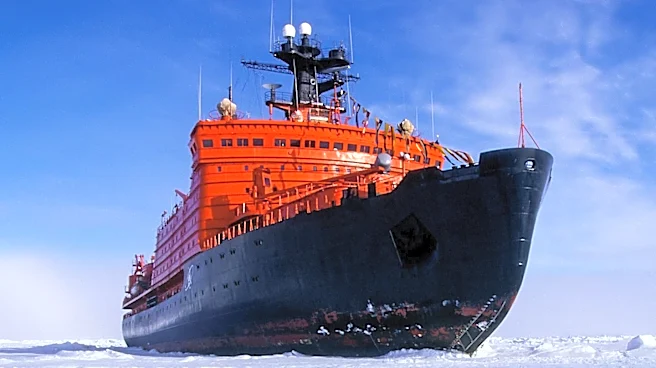
significant geographical, economic, and political limitations. Currently, the NSR handles less than 0.5% of weekly vessel transits between East Asia and Europe compared to conventional routes. Although the NSR offers substantial distance savings for some voyages between northern Europe and Northeast Asia, these savings do not necessarily translate into lower costs. Ice conditions restrict navigation, particularly in winter, often requiring ice-class vessels or icebreaker assistance. Russia also imposes navigation requirements and charges, adding to costs and administrative complexities. Furthermore, environmental and operational risks are high, with limited search-and-rescue infrastructure and the potential for exceptionally difficult oil spill containment in remote, ice-covered waters. Western sanctions against Russia introduce additional financial and legal complications, making the route less attractive for international shipping companies.
Why It's Important?
The unsuitability of the Arctic as a primary shipping alternative has significant implications for global trade and energy security. The continued reliance on Middle Eastern chokepoints, despite their volatility, means that disruptions in these regions will continue to have a profound impact on international supply chains and energy markets. This situation underscores the vulnerability of global commerce to geopolitical instability in critical maritime passages. For the United States and its allies, it means that efforts to diversify shipping routes to enhance resilience against regional conflicts or blockades are severely limited in the short to medium term. The economic and logistical challenges of the NSR, coupled with the political complexities of dealing with Russia, prevent it from becoming a reliable alternative, thus maintaining the strategic importance and inherent risks associated with traditional routes through the Middle East. This also highlights the ongoing challenge of balancing energy security with geopolitical considerations, particularly concerning Russian energy exports.
What's Next?
Given the limitations of the Northern Sea Route, shipping companies and governments will likely continue to focus on managing risks associated with existing Middle Eastern shipping lanes. This may involve increased naval presence, diplomatic efforts to de-escalate regional conflicts, and exploring alternative, albeit longer, routes that bypass the most volatile chokepoints. The primary contribution of the Arctic to the current crisis may instead come from Russian Arctic energy exports, such as the Vostok Oil project and the Arctic LNG 2 project. However, expanding these projects presents Western governments with a dilemma: whether improving energy security justifies relaxing sanctions that constrain Russia's ability to finance its war against Ukraine. Production and shipping constraints also limit the immediate contribution of these projects, and redirecting existing exports would not significantly increase global output. Therefore, the immediate future will likely see continued reliance on traditional routes and ongoing efforts to mitigate risks in the Middle East.
Beyond the Headlines
The discussion around Arctic shipping routes extends beyond immediate logistical concerns to broader geopolitical and environmental implications. The increased accessibility of Arctic waters due to climate change opens up new strategic frontiers, potentially leading to increased competition for resources and influence in the region. While commercial shipping may not fully materialize, the strategic importance of the Arctic for resource extraction, particularly energy, remains high. This creates a complex interplay between environmental concerns, economic opportunities, and national security interests. The challenges of operating in the Arctic also highlight the need for robust international cooperation on environmental protection, search and rescue, and navigation safety, which are currently complicated by geopolitical tensions. The long-term implications include potential shifts in global power dynamics as nations vie for control and access to Arctic resources and transit routes, even if those routes do not fully replace established global shipping arteries.