



What's Happening?
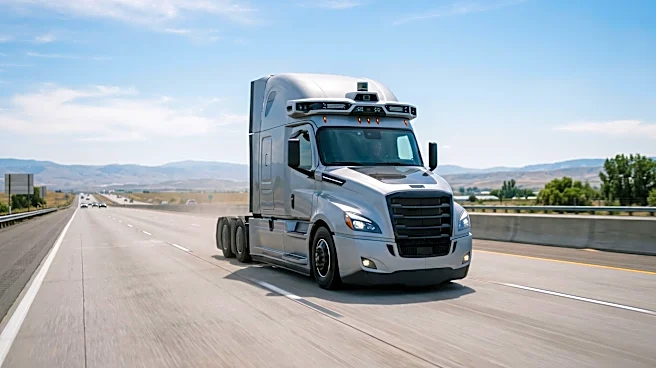
Bot Auto, a Houston-based company, has introduced its 'Capacity Grid,' a new freight transportation network designed to integrate customer demand with autonomous trucking capabilities. This launch is accompanied by agreements totaling 200 million miles
for driverless freight operations. The platform allows shippers and freight brokers to pre-book driverless trucking capacity, specifying routes, schedules, and agreed-upon prices. A significant part of these agreements includes a 50-million-mile commitment with FreightVana, a Phoenix-based logistics firm specializing in power-only freight transportation. Bot Auto's approach shifts from managing individual autonomous trucks to coordinating a comprehensive freight network, aiming to optimize vehicle utilization and reduce operating costs. Unlike other autonomous trucking technology providers, Bot Auto owns and operates its fleet, offering transportation services directly to customers without requiring them to purchase or maintain autonomous vehicles.
Why It's Important?
This development is crucial for the U.S. trucking industry, which faces ongoing challenges such as high operating costs, driver shortages, and fluctuating freight capacity. Bot Auto's model, by leveraging autonomous vehicles, could provide a solution to these issues by enabling more consistent operations, particularly on established highway routes and for overnight services. The company's business model, which focuses on maximizing vehicle operating time, aims to spread fixed costs over more revenue-generating miles, potentially making autonomous trucking commercially viable. The agreement with FreightVana highlights the potential for significant economic improvements for both autonomous trucking providers and logistics companies, as humanless trucks can operate without the same driver rest requirements, leading to increased efficiency and predictability in logistics planning.
What's Next?
Bot Auto has not yet specified a timeline for completing the full 200 million miles covered by its new agreements. However, the company's strategy involves expanding its commercial operations, building on its existing customer base which includes J.B. Hunt, Ryan Transportation, and Steves & Sons. The 'Capacity Grid' is intended to provide the commercial framework necessary for this expansion by securing customer demand before additional fleet capacity is introduced. This move aims to solidify a repeatable business model for large-scale commercial operations, moving beyond just demonstrating the technical feasibility of driverless trucks. Further investment in vehicles, maintenance facilities, operational oversight, and supporting infrastructure will be necessary to scale driverless trucking beyond its current limited commercial routes.
Beyond the Headlines
The introduction of Bot Auto's 'Capacity Grid' signifies a deeper shift in the logistics and transportation sector, moving towards a more automated and integrated future. This model could trigger significant changes in labor markets, particularly for truck drivers, as autonomous technology becomes more prevalent. While it addresses current industry pain points like driver shortages, it also raises questions about job displacement and the need for workforce retraining. Furthermore, the legal and regulatory frameworks surrounding autonomous vehicle operation, insurance liabilities, and cross-state operations will need to evolve to accommodate this new paradigm. The pilot program at Fort Hood also suggests potential military applications for autonomous logistics, indicating a broader impact on national infrastructure and defense capabilities.