





What's Happening?
The filming locations for the 2019 folk horror film 'Midsommar' have been detailed, revealing that while the story is set in rural Sweden, much of the production took place elsewhere. The prologue, depicting the home of the character Dani (Florence Pugh),
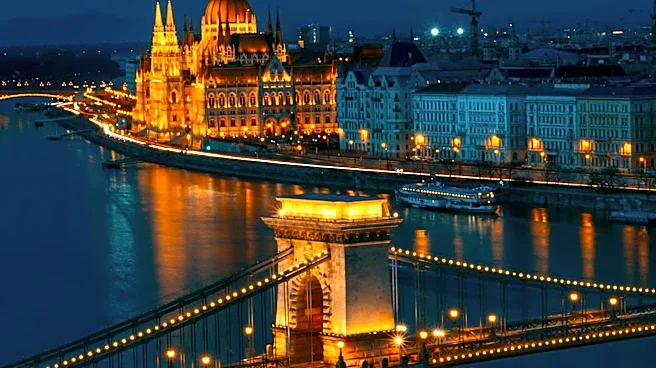
was filmed in Draper, Utah, specifically at 1247 Bridle Trail Road, approximately 20 miles south of Salt Lake City. Dani's apartment scenes were shot in Williamsburg, Brooklyn, New York. The majority of the film, including the construction of the Hårga commune village, was filmed in Hungary. Korda Studios in Etyek, west of Budapest, served as the production base. The village itself was built from scratch in a field near the Farkashegy airfield south of Budakeszi, a town between Etyek and Budapest. An old stone quarry, Régi kőbánya, northwest of this field, was used for the clifftop scenes. The decision to film in Hungary was primarily due to the eight-hour daily filming limit in Sweden, which was impractical for a production requiring extensive daylight scenes.
Why It's Important?
The revelation of 'Midsommar's' diverse filming locations highlights a common practice in the film industry where production often occurs in areas that offer logistical advantages, financial incentives, or more flexible regulations, even if the narrative is set elsewhere. For Utah and New York, hosting parts of a major film production can bring economic benefits through local spending on services, labor, and accommodations, albeit for a limited duration in this case. For Hungary, becoming a primary filming location for a significant portion of the movie underscores its growing role as an international film production hub, attracting foreign investment and showcasing its infrastructure and scenic versatility. This practice allows filmmakers to achieve their creative vision while navigating practical constraints, but it also means that the 'authenticity' of a film's setting can often be a carefully constructed illusion, relying on art direction and set design to transport audiences to a different geographical or cultural context.
What's Next?
While 'Midsommar' has already been released, the detailed information about its filming locations could influence film tourism, potentially drawing fans to visit the specific sites in Utah, New York, and Hungary. For the film industry, this case further exemplifies the global nature of production and the strategic decisions made regarding location scouting. Future productions may continue to leverage countries like Hungary for their production capabilities and cost-effectiveness. The film's success and the interest in its behind-the-scenes details could also encourage local film commissions in Utah and New York to highlight their capacity to host diverse productions, from intimate prologue scenes to larger-scale sequences. The ongoing trend of international co-productions and location diversification is likely to continue, driven by economic and logistical considerations.
Beyond the Headlines
The use of disparate locations for 'Midsommar' raises interesting questions about the perception of authenticity in cinema and the art of world-building. By meticulously constructing the 'Swedish' village in Hungary, the filmmakers demonstrated how a convincing sense of place can be created through set design and cultural research, even when geographically removed from the actual setting. Director Ari Aster and his team reportedly visited the Decorated Farmhouses of Hälsingland in central Sweden, a UNESCO World Heritage Site, to draw inspiration for the film's aesthetic and iconography. This blend of genuine cultural inspiration with practical filming locations highlights the complex interplay between artistic vision, logistical realities, and the audience's suspension of disbelief. It also subtly points to the globalized nature of creative industries, where talent and resources are drawn from various parts of the world to bring a story to life, transcending national borders in the process of storytelling.