


What's Happening?
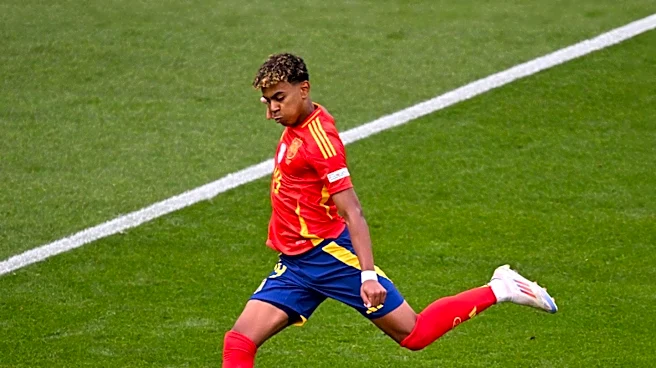
Lamine Yamal, the Barcelona winger, has publicly questioned the current criteria for the Ballon d'Or award, arguing that it has strayed from its original purpose of identifying the world's best footballer. In an interview on Movistar Plus’ Universo Valdano,
Yamal stated that factors such as team trophies, individual statistics, and a player's club identity should not automatically determine the winner. He drew a comparison to the era of Lionel Messi and Cristiano Ronaldo, suggesting that the award's criteria were clearer when those two players dominated. Yamal specifically criticized the idea that winning the Champions League should automatically lead to a Ballon d'Or for a player from the winning team, using Paris Saint-Germain as an example. He also argued against prioritizing goal-scoring statistics, noting that there are separate awards for top scorers. For Yamal, the true essence of football lies in the enjoyment of the game itself, rather than solely focusing on numerical achievements.
Why It's Important?
Yamal's comments are significant as they challenge the prevailing narrative and metrics often used to evaluate individual player performance in elite football. His perspective highlights a potential shift in how younger generations of players perceive success and contribution to the sport, moving beyond mere statistics to a more holistic view of impact and enjoyment. This could influence future discussions around player awards and the criteria used by voters, potentially leading to a re-evaluation of what constitutes 'best' in football. If his views gain traction, it might encourage a broader appreciation for different styles of play and contributions that don't always translate into goals or assists. This could also impact how clubs scout and develop talent, placing more emphasis on overall game involvement and technical artistry rather than just statistical output. The debate over Ballon d'Or criteria reflects a larger conversation within sports about the balance between individual brilliance and team success, and the role of data versus subjective appreciation.
What's Next?
Yamal's statements are likely to spark further debate among football pundits, fans, and players regarding the Ballon d'Or and other individual awards. His perspective, coming from a rising star, could influence how future generations of players articulate their value and how the media covers individual achievements. It remains to be seen if award committees will consider these evolving viewpoints in their selection processes. The discussion may also prompt a deeper look into the historical context of the Ballon d'Or and whether its original intent has been maintained. As football continues to evolve, with increasing reliance on advanced statistics, Yamal's emphasis on the 'show' and 'enjoyment' of the game could represent a counter-narrative that gains momentum, particularly among those who value the aesthetic and artistic aspects of football.
Beyond the Headlines
Beyond the immediate discussion of the Ballon d'Or, Yamal's comments touch upon a broader philosophical question about the nature of excellence in competitive fields. His emphasis on the 'enjoyment' of the game and the 'whole move' rather than just the final statistic suggests a deeper appreciation for the process and artistry involved. This perspective challenges the modern trend of hyper-quantification in sports, where player value is often reduced to numbers. It raises ethical considerations about how we define and reward success, and whether an over-reliance on statistics can obscure the true essence of a player's contribution. Culturally, it speaks to a potential generational shift in values, where personal fulfillment and the quality of the experience might be prioritized over purely objective achievements. This could have long-term implications for how sports are consumed, coached, and celebrated, fostering a more nuanced understanding of athletic prowess.