







What's Happening?
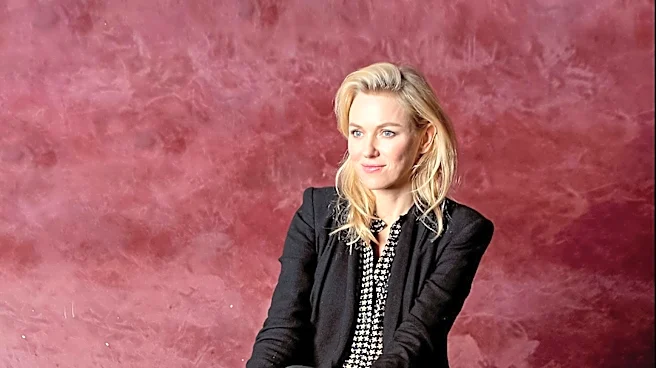
Before achieving movie stardom, Naomi Watts featured in an NBC science fiction series titled 'Sleepwalkers,' which was canceled after only two episodes aired. The show premiered on November 1, 1997, as part of NBC's 'Thrillogy' programming block. Watts played
Kate Russell, a dream interpreter and psychologist who utilized advanced technology to enter people's dreamscapes to help them confront their subconscious issues. Despite producing nine episodes, only two were broadcast due to poor Nielsen ratings. Five additional episodes were aired exclusively on the West Coast the following year, but the final two never made it to air in the United States. The series faced creative clashes between its creators, Stephen Kronish and David S. Goyer, and NBC executives, who were concerned about audience reception to the show's surreal elements and a lack of cohesion in artistic styles. This early cancellation marked a challenging start to Watts' career in television.
Why It's Important?
The swift cancellation of 'Sleepwalkers' highlights the volatile nature of television programming and the significant impact of network executives' decisions and audience ratings on a show's longevity. For actors like Naomi Watts, such early career setbacks can be pivotal, demonstrating resilience and the need to pursue diverse opportunities. While 'Sleepwalkers' itself did not achieve success, Watts' subsequent rise to movie stardom underscores that early failures do not necessarily define an actor's long-term career trajectory. This instance also reflects NBC's struggle with its 'Thrillogy' block, which saw other shows like 'Dark Skies' and 'The Others' also canceled, indicating a broader challenge in establishing a successful sci-fi/thriller programming strategy during that period. The show's fragmented broadcasting and limited availability also illustrate how content can become obscure without proper network support, regardless of its intriguing premise.
What's Next?
While 'Sleepwalkers' is long past its broadcast window, its legacy serves as a footnote in Naomi Watts' distinguished career. For Watts, her path led to significant success in film, including her breakout role in 'Mulholland Drive,' and continued work in television, notably in recent Ryan Murphy productions like 'The Watcher' and 'Feud: Bette & Joan.' The series itself remains a curiosity for fans of Watts and sci-fi enthusiasts, with its limited availability making a comprehensive evaluation difficult. The experience of 'Sleepwalkers' likely contributed to Watts' understanding of the entertainment industry's demands and the importance of selecting projects with strong creative alignment and network backing. For NBC, the failure of 'Thrillogy' led to the eventual discontinuation of the programming block, prompting a re-evaluation of its genre-specific content strategies.
Beyond the Headlines
The story of 'Sleepwalkers' delves into the deeper implications of creative control versus commercial viability in television production. The reported clashes between creators and network executives over artistic direction versus audience appeal are common in the industry, often leading to compromises that can dilute a show's original vision or, as in this case, lead to its premature demise. The show's premise, involving dream interpretation and the subconscious, touches on themes that could have offered rich psychological exploration, but the network's apprehension about surrealism suggests a preference for more conventional storytelling at the time. This situation also highlights the subjective nature of 'good' television, where critical acclaim and audience engagement don't always align, and how a show's potential can be lost due to external pressures rather than inherent flaws in its concept or performances. Watts' ability to transcend this early setback speaks to her talent and adaptability in a highly competitive field.