





What's Happening?
SoftBank has committed close to $80 billion to artificial intelligence (AI) investments since 2024. This substantial figure includes a $64.6 billion stake in OpenAI, following a $30 billion follow-on investment completed on October 1, which brought SoftBank's
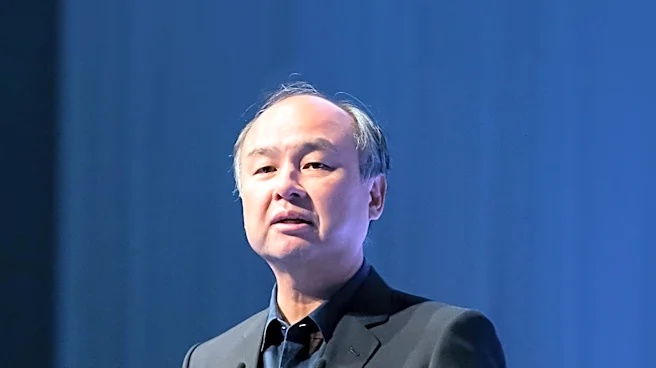
total stake in OpenAI to approximately 13%. The total also encompasses acquisitions such as Ampere Computing for $6.5 billion, ABB Robotics for $5.375 billion, and DigitalBridge for about $3.1 billion. Final decisions on these major commitments are delegated by SoftBank's board to Chairman and Chief Executive Masayoshi Son and Chief Financial Officer Yoshimitsu Goto. The funding for these investments has been secured through various means, including repaying a $40 billion loan, obtaining an $11.87 billion two-year loan from multiple banks, and a $10 billion margin loan backed by its OpenAI stake. Additionally, SoftBank sold $10 billion in dollar and €1 billion in euro senior unsecured notes in September.
Why It's Important?
SoftBank's aggressive investment strategy underscores a significant belief in the transformative power of AI and its related infrastructure. The nearly $80 billion commitment highlights the massive capital flowing into the AI sector, indicating a global race to dominate this emerging technological frontier. This level of investment by a major global player like SoftBank can accelerate AI development and deployment, potentially leading to breakthroughs across various industries. The focus on 'Physical AI,' as articulated by Masayoshi Son, suggests a strategic vision that extends beyond software to encompass robotics, computing, connectivity, and scalable infrastructure. This could drive innovation in areas like automation, data centers, and digital infrastructure, impacting global supply chains and technological capabilities. The funding mechanisms, involving substantial borrowing, also reflect a high-stakes approach to capturing market leadership in AI.
What's Next?
SoftBank's next quarterly results, due in November, will provide further insight into the financial implications of these extensive AI commitments and how the company's balance sheet is absorbing the increased debt. The ongoing early-stage talks to acquire Allied Universal, a U.S. security services company, for up to $18 billion in equity (or $30 billion including debt), suggest SoftBank's AI investment spree may continue, potentially pushing total commitments well over $100 billion. The structure of delegating final investment decisions to Son and Goto will likely remain under scrutiny, especially as the scale of investments grows. The conversion timing of SoftBank's preferred shares in OpenAI into common stock is contingent on OpenAI's potential public offering, which CEO Sam Altman has indicated will not occur this year, leaving the timing open. Market reactions to SoftBank's financial maneuvers, such as recent stock fluctuations following borrowing details and acquisition reports, will continue to be a key indicator of investor confidence.
Beyond the Headlines
SoftBank's concentrated investment strategy in AI, particularly the delegation of final decision-making to Masayoshi Son and Yoshimitsu Goto, raises questions about corporate governance and risk concentration. While this centralized approach may enable swift decision-making in a fast-evolving sector, it also places significant responsibility and potential risk on a few individuals. The substantial reliance on borrowed money to fund these AI ventures could increase SoftBank's leverage, a factor Fitch has already noted, and could have broader implications for financial stability if the AI investments do not yield expected returns. This aggressive funding model for AI infrastructure is not unique to SoftBank, suggesting a potential systemic trend where large tech players are taking on considerable debt to secure their positions in the AI race. The long-term success of these 'Physical AI' bets will depend on their ability to integrate and generate value across diverse sectors, from robotics to digital infrastructure, shaping the future of AI's real-world applications.