





What's Happening?
Economist and Allianz Chief Economic Adviser Mohamed El-Erian has stated that the recent market turbulence surrounding Nvidia Corp. highlights significant risks for investors in the coming months. Despite Nvidia's rebound, El-Erian noted the 'incredible
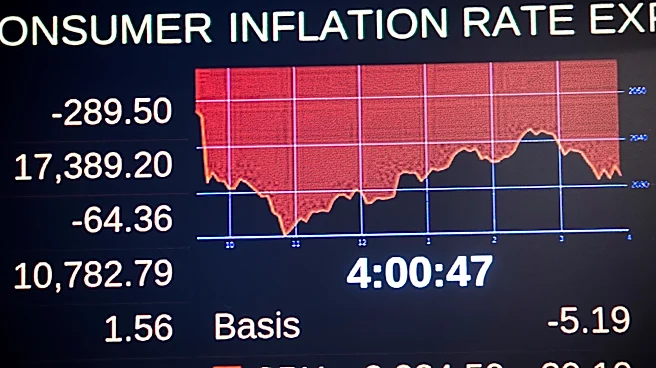
volatility' in the Nasdaq, with cumulative upward and downward movements amounting to roughly 25% over a brief period, including a previous Friday's sell-off. He questioned whether this extreme price action indicates healthy price discovery or an equity market struggling to find a stable valuation anchor. Beyond Nvidia's corporate dynamics, El-Erian raised concerns about corporate governance, the sustainability of massive AI infrastructure spending, and the influence of national security, export controls, geopolitics, and U.S. industrial policy on the technology sector. Other market indicators, such as declining sovereign bond yields, pressure on commodities, sliding copper prices, and crude oil's worst monthly performance since the pandemic era, paint a cautious picture.
Why It's Important?
El-Erian's warnings are important because they suggest that the volatility seen in the technology sector, particularly with a major player like Nvidia, could be a harbinger of broader economic instability. The potential for 'bad technicals' in the market to spill over into 'bad fundamentals' in the real economy could impact U.S. industries and economic stakeholders. If the market is indeed struggling to find a stable valuation anchor, it could lead to increased uncertainty for investors and businesses. The sustainability of AI infrastructure spending, influenced by geopolitical factors and U.S. industrial policy, has significant implications for technological advancement and economic growth. Furthermore, the cautious signals from other market indicators, despite resilient U.S. economic data like revised GDP growth, indicate underlying vulnerabilities that could affect various sectors and consumer confidence.
What's Next?
Investors are advised to closely monitor upcoming economic data, with November's nonfarm payrolls report being a key focus. Inflation remains a challenge, as indicated by October's personal consumption expenditures (PCE) report showing annual headline inflation at 3.8% and core inflation at 3.3%. This reinforces expectations for another 25-basis-point Federal Reserve rate hike at its upcoming meeting, with odds standing at 98.4% for a December hike. Such a move by the Federal Reserve would impact borrowing costs for businesses and consumers, potentially influencing investment decisions and economic activity. The ongoing scrutiny of corporate governance within the tech industry and the broader implications of AI infrastructure spending will also continue to shape market dynamics and policy discussions.
Beyond the Headlines
The concerns raised by El-Erian extend beyond immediate market fluctuations, touching upon deeper structural issues within the U.S. economy and the technology sector. The questioning of 'healthy price discovery' in the equity market suggests a potential disconnect between asset valuations and underlying economic realities, which could have long-term implications for capital allocation and investment strategies. The interplay between the Trump administration and the technology industry, as well as the role of national security and industrial policy in shaping the AI ecosystem, highlights the increasing politicization of economic sectors. This could lead to shifts in regulatory frameworks, trade policies, and international competitiveness, impacting U.S. innovation and global economic leadership. The sustainability of massive AI spending plans also raises ethical and societal questions regarding resource allocation and the potential for technological bubbles.