






What's Happening?
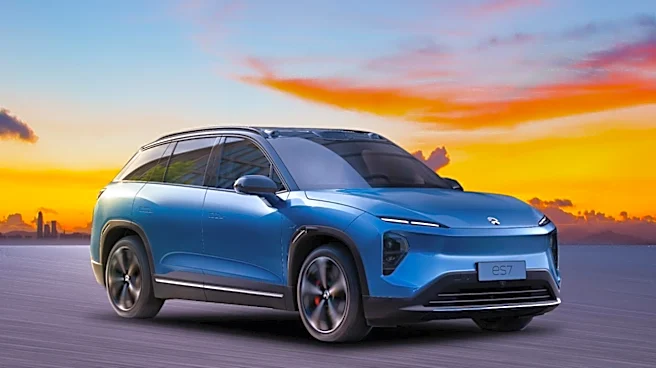
NIO, a smart electric vehicle manufacturer, announced significant delivery figures for October 2026, totaling 34,246 vehicles across its NIO, ONVO, and FIREFLY brands. This brings the cumulative deliveries to 1,332,139 as of October 31. The NIO All New
ES8 model has been a strong performer, leading its large SUV and RMB400,000 level segments in China year-to-date. In conjunction with these delivery updates, NIO CEO William Li has publicly called for national electric vehicle (EV) weight limits. Li's advocacy for these limits is aimed at aligning with the company's strategic focus on battery swapping technology and smart driving systems, rather than the industry trend of developing increasingly larger battery packs. The company's investment narrative is currently influenced by these strong October deliveries and Li's comments regarding EV weight regulations.
Why It's Important?
The strong delivery numbers from NIO in October 2026 are crucial for the company's investment narrative, indicating sustained demand for its multi-brand approach and product pipeline. This performance helps test whether the company's three-brand architecture is gaining sufficient traction to support factory utilization and fixed cost absorption, which are vital for achieving profitability. CEO William Li's push for national EV weight limits could have broader implications for the EV industry. If adopted, such regulations could shift the focus from larger battery packs to alternative solutions like battery swapping and smart driving, potentially benefiting companies like NIO that have invested heavily in these technologies. This move could also influence future EV design and infrastructure development, impacting competitors and the overall market direction.
What's Next?
The immediate focus for NIO will be on sustaining its monthly delivery throughput and demonstrating clearer progress on improving vehicle margins and reducing cash burn. The company's ability to maintain this momentum as it expands its power network and rolls out new models, such as the ES9 and ONVO L80, will be closely watched. Any challenges in execution, network utilization, or pricing discipline could negatively impact vehicle margins, free cash flow, and investor sentiment ahead of upcoming earnings releases. Furthermore, the discussion around national EV weight limits, as advocated by CEO William Li, will likely continue. The outcome of this advocacy could shape future regulatory landscapes for EVs, potentially influencing product development strategies across the industry and creating a more favorable environment for NIO's battery swapping and smart driving technologies.
Beyond the Headlines
NIO's emphasis on battery swapping and smart driving, coupled with CEO William Li's call for EV weight limits, highlights a potential divergence in the future of EV development. While many manufacturers focus on increasing battery size for extended range, NIO is championing an alternative that prioritizes efficiency, infrastructure, and potentially lighter vehicles. This approach could lead to a more sustainable and resource-efficient EV ecosystem, reducing the demand for raw materials associated with large batteries and potentially lowering the environmental impact of EV manufacturing. The debate over EV weight limits also touches upon safety concerns, road infrastructure wear, and energy consumption, suggesting a broader conversation about the optimal design and regulatory framework for electric vehicles as they become more prevalent on U.S. roads.