





What's Happening?
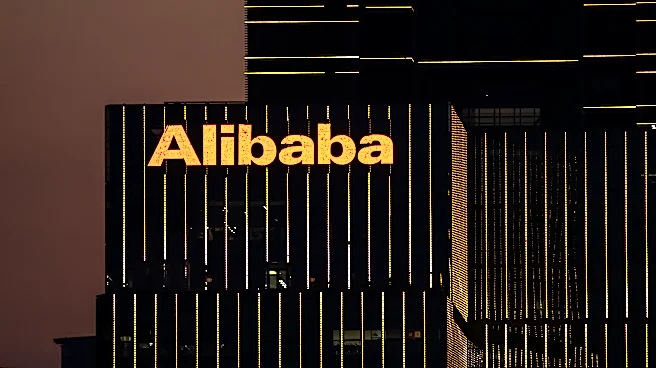
Alibaba Group Holding shares saw a 3.60% increase in premarket trading, reaching $103.97, driven by improving sentiment towards Chinese equities and Alibaba's strategic expansion in artificial intelligence (AI). Alibaba Chairman Joe Tsai reiterated that
open-source technology is a core component of the company's AI strategy. The company's Qwen AI models are set to be integrated into Apple Intelligence in China by December, powering features like Siri, writing tools, and visual intelligence. Alibaba is also extending the commercial use of Qwen through its e-commerce platforms, with a recent Singles' Day livestream selling nearly 100,000 monthly QwenWork subscriptions in about 30 minutes, corresponding to approximately 2 trillion AI tokens. Alibaba is financing its AI infrastructure and model development with roughly $25 billion in free cash flow from its core e-commerce operations, having doubled its computing capital spending annually over the past three years.
Why It's Important?
This development is significant for U.S. investors and the global technology market. Alibaba's stock surge reflects a broader recovery in Chinese equities, which could signal renewed investor confidence in the region. The integration of Alibaba's Qwen AI models into Apple Intelligence in China highlights the increasing interdependence of global tech giants and the strategic importance of the Chinese market for AI deployment. For U.S. tech companies, this partnership underscores the necessity of navigating complex international collaborations and competitive landscapes. Joe Tsai's emphasis on open-source AI as a central strategy indicates a potential divergence in AI development philosophies between China and some U.S. counterparts, which could influence future innovation, intellectual property, and regulatory discussions. The substantial investment by Alibaba in AI infrastructure, funded by its e-commerce profits, positions it as a formidable player in the global AI race, potentially impacting U.S. companies vying for AI leadership and market share.
What's Next?
Alibaba is scheduled to release its earnings on November 24, 2026, with analysts projecting increased earnings per share and revenue, which could further influence investor sentiment. The ongoing integration of Qwen into Apple Intelligence will be a key indicator of its market adoption and performance. The company's continued investment in AI, particularly in the face of restricted access to advanced AI processors, suggests a focus on developing its internal T-Head chips and domestic AI infrastructure. This could lead to greater self-sufficiency in China's AI sector, potentially reducing reliance on foreign technology. U.S. investors and tech companies will closely monitor these developments, as they could impact supply chains, market access, and competitive dynamics in the AI industry. The success of Alibaba's open-source AI strategy and its commercial applications will also provide valuable insights into the future direction of AI development globally.
Beyond the Headlines
The rise of Alibaba's stock and its aggressive AI expansion, particularly with an open-source focus, points to a deeper strategic shift in the global technology landscape. The partnership with Apple, a prominent U.S. company, in the Chinese market, illustrates the complex interplay between geopolitical tensions and commercial imperatives. While the U.S. and China are often seen as rivals in the tech sphere, such collaborations highlight areas of mutual benefit and technological convergence. Joe Tsai's commitment to open-source AI also raises questions about the long-term implications for data privacy, security, and ethical AI development, especially as these models become more pervasive. The ability of Alibaba to fund its extensive AI initiatives through its e-commerce free cash flow demonstrates the power of diversified tech conglomerates to drive innovation, potentially setting a precedent for how other global tech giants approach AI investment and development.