





What's Happening?
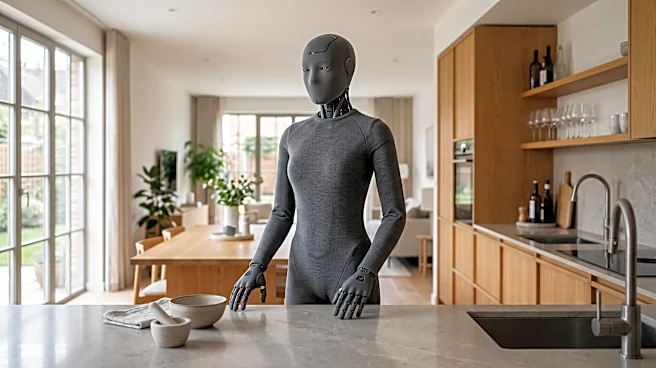
Bernt Børnich, CEO of 1X, has commented on the privacy implications of the company's NEO humanoid robots. The NEO robots, available for pre-order since October 2025 at $20,000 or $499 per month, utilize cameras that allow human remote operators to view
the interior of customers' homes. During initial operations, particularly for complex tasks, human operators wearing VR headsets control the robots. Børnich stated that customers purchasing the robot in 2026 implicitly accept a 'social contract,' acknowledging that 1X requires user data to enhance the product. While facial blurring is implemented, the company's access to camera feeds means that home layouts and contents are visible to operators. This raises significant privacy questions regarding the extent of data collection and its use in a domestic setting. The company's stance emphasizes product improvement through data, placing the onus on the consumer to accept these terms.
Why It's Important?
The statements from 1X CEO Bernt Børnich highlight a critical emerging challenge in the rapidly expanding humanoid robot market: the balance between technological advancement, product utility, and user privacy. As these robots are designed for integration into private spaces like homes, the collection of visual data by manufacturers introduces substantial privacy risks. The 'social contract' concept articulated by Børnich suggests a shift in consumer expectations, where the trade-off for advanced robotic assistance might be a significant reduction in personal data control. This could set a precedent for how future smart home devices and personal robots handle sensitive user information. For U.S. consumers, this raises concerns about data security, potential misuse of visual data, and the lack of clear regulatory frameworks governing such advanced data collection in private residences. The implications extend to legal and ethical debates surrounding surveillance, consent, and the rights of individuals in an increasingly connected and automated environment.
What's Next?
The ongoing development and deployment of humanoid robots like 1X NEO will likely intensify discussions around data privacy regulations and consumer protection. As more of these devices enter homes, there will be increased pressure on policymakers to establish clear guidelines for data collection, storage, and usage by robot manufacturers. Consumers may demand more transparent data policies and stronger assurances regarding the security of their private information. It is also probable that privacy advocacy groups will scrutinize companies like 1X, pushing for stricter consent mechanisms and limitations on remote human oversight into private spaces. The industry may see a push for on-device processing of data to minimize transmission to external servers, or the development of privacy-preserving technologies. Future product iterations might need to incorporate more robust privacy features to gain broader consumer trust and acceptance, potentially influencing design and operational choices for domestic robots.
Beyond the Headlines
The 'social contract' proposed by 1X CEO Bernt Børnich touches upon deeper societal implications regarding the nature of privacy in an age of pervasive AI and robotics. It suggests a future where the convenience of advanced technology comes with an implicit agreement to surrender a degree of personal privacy, transforming the home from a private sanctuary into a data-generating environment accessible by external entities. This raises ethical questions about informed consent, especially when the full scope of data collection and its potential uses may not be entirely clear to the average consumer. Legally, it challenges existing privacy frameworks, which may not be adequately equipped to address real-time visual data collection from inside private residences by AI-powered devices. Culturally, it could lead to a redefinition of privacy expectations, where constant monitoring by technology becomes normalized, potentially eroding traditional notions of personal space and autonomy. The long-term shift could be towards a society where individuals are constantly evaluated and understood through the data generated by their interactions with smart devices, impacting everything from personal security to consumer behavior analysis.