



What's Happening?
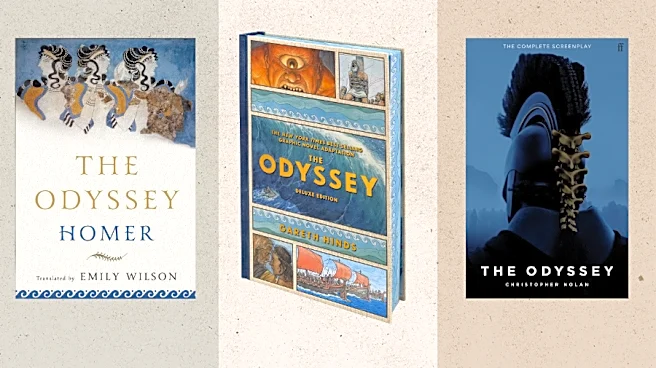
Emily Wilson, a renowned classicist and the first woman to translate Homer's 'The Odyssey' into English, has criticized Christopher Nolan's film adaptation of the epic. Despite Nolan citing Wilson's translation as an inspiration, Wilson expressed disappointment
in a review for The London Review of Books. She described the screenplay as 'abysmal' and criticized the film for its lack of psychological, emotional, and ethical depth. Wilson noted that while adaptations need not strictly adhere to the original text, Nolan's version lacked restraint and failed to capture the human scale of the story. Despite her critique, Wilson acknowledged that the film has sparked renewed interest in Homer's work, with translations, including her own, seeing increased sales.
Why It's Important?
Wilson's critique highlights the challenges filmmakers face when adapting classic literature for modern audiences. Her comments underscore the importance of depth and authenticity in storytelling, especially when dealing with revered texts like 'The Odyssey'. The film's success in drawing attention to classical literature could have positive implications for educational institutions, potentially influencing curriculum decisions and funding for literature and history departments. Additionally, the film's box office success and the ensuing debate may encourage more filmmakers to explore classical themes, albeit with a focus on maintaining the integrity of the source material.
What's Next?
The film's reception and Wilson's critique may prompt discussions among filmmakers and scholars about the balance between creative freedom and fidelity to source material. As 'The Odyssey' continues to perform well at the box office, it is likely to remain a topic of conversation in both cinematic and academic circles. The film's success could lead to further adaptations of classical works, potentially influencing how these stories are taught and perceived in contemporary culture.
Beyond the Headlines
Wilson's review also touches on broader cultural themes, such as the role of adaptations in preserving and transforming cultural heritage. Her critique raises questions about the responsibilities of filmmakers when interpreting historical texts and the impact of their creative choices on public understanding of these works. The film's ability to drive book sales suggests a positive side effect of cinematic adaptations, potentially encouraging a wider audience to engage with classical literature.