




What's Happening?
Textron Inc. (NYSE: TXT) has announced a definitive agreement to sell its entire Industrial segment to an affiliate of Kingswood Capital Management for $1.2 billion. This strategic move, announced on November 18, 2026, aims to transform Textron into a pure-play
aerospace and defense company. The Industrial segment includes various businesses and brands such as Kautex, Pentatonic, Textron Specialized Vehicles, E-Z-GO, PACE Technologies, TUG Technologies, Douglas Equipment, Premier, Safeaero, Ransomes, Jacobsen, and Cushman. The transaction is anticipated to generate approximately $1.1 billion in net cash proceeds for Textron after taxes and transaction-related expenses. Concurrently, Textron's board has authorized the repurchase of up to 35 million shares of common stock, replacing a previous authorization from February 2026. This authorization is intended to support buybacks related to the divestiture, offset share dilution from stock-based compensation, and provide flexibility for capital management. The sale is expected to close in the first half of 2027, pending regulatory approvals and customary closing conditions. Goldman Sachs & Co. LLC is serving as the exclusive financial advisor, and Latham & Watkins LLP is the legal advisor to Textron.
Why It's Important?
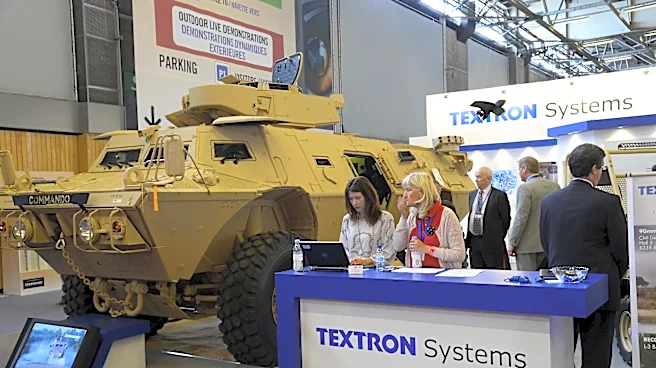
This divestiture is a significant strategic shift for Textron, allowing it to sharpen its focus on its core aerospace and defense businesses, which include Textron Aviation (Cessna and Beechcraft), Bell (military and commercial rotorcraft), and Textron Systems (aerospace and defense products and services). By streamlining its portfolio, Textron aims to capitalize on the strong demand currently observed in the aerospace and defense sectors, driven by factors such as robust business jet demand, increased defense spending, and growth in commercial aviation aftermarket services. The move is expected to enhance Textron's financial performance and market valuation, as evidenced by a 4.1% rise in its shares in premarket trading following the announcement. For investors, this signals a clearer investment thesis tied directly to the cycles of the aerospace and defense markets. The company's commitment to returning capital to shareholders through the authorized share repurchase program also indicates confidence in its future financial health and a dedication to enhancing shareholder value.
What's Next?
The transaction is slated to close in the first half of 2027, subject to obtaining necessary regulatory approvals and fulfilling other customary closing conditions. Upon completion, Textron will operate as a pure-play aerospace and defense entity, with projected 2026 revenues exceeding $12 billion and a backlog of $19 billion. The company plans to utilize a portion of the net cash proceeds from the sale to fund additional share repurchases in 2027, further demonstrating its commitment to capital return. Textron's Industrial segment will be reclassified as 'held for sale' and presented as discontinued operations starting in the fourth quarter of 2026, with historical results similarly reclassified in its Annual Report on Form 10-K for the year ending January 2, 2027. The company will continue to prioritize a strong balance sheet, investing in research and development, capital expenditures, and opportunistic capital management.
Beyond the Headlines
This strategic divestiture by Textron reflects a broader trend among diversified manufacturers to shed non-core assets and concentrate on segments experiencing the strongest market demand. By narrowing its focus to aerospace and defense, Textron is aligning its portfolio with current industry tailwinds, potentially leading to more stable and predictable revenue streams. This specialization could also foster greater innovation and efficiency within its core businesses, as management attention and capital allocation will be more concentrated. However, this also means Textron's future performance will be more directly tied to the cyclical nature of the aerospace and defense markets, making it more susceptible to fluctuations in these sectors. The move highlights the ongoing evolution of industrial conglomerates, as they adapt to changing global economic conditions and investor preferences for more focused business models. The successful execution of this strategy could serve as a blueprint for other diversified companies considering similar portfolio optimizations.