



What's Happening?
SenseTime has open-sourced its SenseNova 6.8 Code2Video model, a 27B video model fine-tuned from Qwen3.8-27B. This model, licensed Apache 2.0, offers a 512K context window and was formally launched on October 28. Unlike traditional diffusion models that
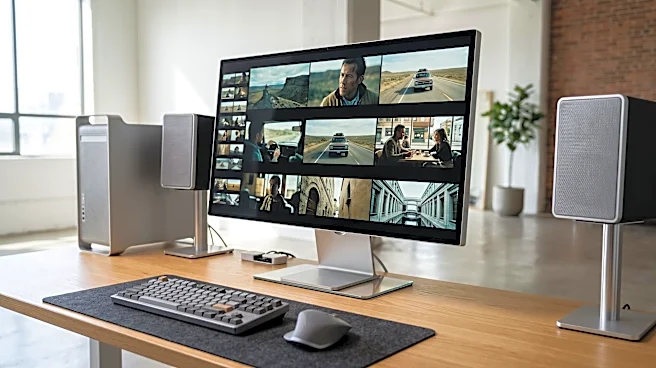
sample frames, Code2Video generates video by writing executable code that draws each frame as a function of time. It then renders the video, reviews the frames, and allows for revisions. The model is designed to be run on personal GPUs using tools like vLLM, SGLang, or LightLLM, driven by an agent harness. SenseTime has also released a code-video skill on GitHub, which includes eight craft guides for various video styles and rendering tools. The process involves an 'enhance prompt' to expand a basic idea into a detailed production specification, followed by Code2Video generating the scenes, rendering contact sheets, and delivering the final MP4.
Why It's Important?
The introduction of SenseNova 6.8 Code2Video marks a significant shift in AI-powered video generation by focusing on code-based creation rather than pixel sampling. This approach allows for precise editing and manipulation of video elements, as each component is treated as a named object within the code. This capability is particularly valuable for motion design, mathematical explainers, data stories, and product promotions, where accuracy in text, formulas, and chart values is crucial—a common weakness in pixel-based video models. The model's ability to sustain long runs (over 10 hours and 2,000+ turns) suggests its potential for complex and detailed video projects. While it doesn't aim for photorealistic footage, its strength lies in creating editable and structured video content, offering a new paradigm for content creators who need precise control over their visual output.
What's Next?
SenseTime has made the SenseNova 6.8 Code2Video model available as open weights on Hugging Face, allowing developers and researchers to experiment with and integrate the technology. The company also provides a code-video skill on GitHub, complete with craft guides and rendering tools, to facilitate its use. Users will need to set up a reference deploy across four GPUs and install necessary software like Node.js 18+, Python 3, ffmpeg, and Playwright's Chromium. The model is designed for iterative revision, where users can provide notes to edit specific elements, and the system will re-render only the changed parts. This iterative process suggests a future where video creation becomes more akin to software development, with version control and precise modifications. Further developments may include hybrid models that combine the code-based precision of Code2Video with the aesthetic qualities of diffusion models.
Beyond the Headlines
The Code2Video model introduces a fundamental change in how AI approaches video creation, moving from generative pixel-based methods to a more structured, code-driven paradigm. This shift has profound implications for intellectual property and content ownership, as the 'source code' of a video could become a new form of digital asset. It also raises questions about the future of creative workflows, potentially empowering individuals with less traditional video editing skills to produce sophisticated animated content through coding. The emphasis on editable and revisable video content could lead to new forms of interactive media and dynamic storytelling, where narratives can be altered and adapted programmatically. Furthermore, the open-source nature of the model could foster a community of developers who build upon this foundation, creating specialized tools and applications that leverage code-based video generation for diverse industries, from education to marketing.