




What's Happening?
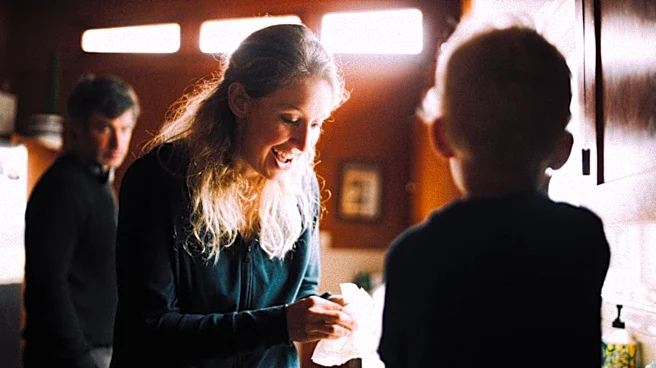
Creators Nathan Fielder and Benny Safdie have elaborated on the intentional discomfort experienced by viewers of their show, 'The Curse.' Fielder explained that the series aims to reflect real-life interactions where individuals often leave things unsaid,
creating an underlying tension that audiences must sit with. He noted that in reality, conversations don't neatly conclude with a 'cut' like in television, and people frequently harbor unspoken feelings. Safdie echoed this sentiment, stating that their interest lies in depicting characters who communicate their true feelings indirectly rather than explicitly. Despite the show's 'cringey' label, Safdie clarified in a December 22, 2023, interview that their primary goal was not to make viewers uncomfortable. Fielder described their guiding principle as 'core honesty,' emphasizing the portrayal of authentic, albeit awkward, human interactions.
Why It's Important?
The creators' insights into 'The Curse' illuminate a deliberate artistic choice that challenges conventional television storytelling. By focusing on unspoken subtext and the discomfort of unresolved communication, the show pushes boundaries in how audiences engage with characters and narratives. This approach can lead to a more profound, albeit unsettling, viewing experience, prompting introspection about real-life social dynamics. For the entertainment industry, this demonstrates a willingness to explore less conventional narrative structures and character development, potentially influencing future creators to experiment with similar themes. It also highlights a growing trend in media to portray more nuanced and less idealized versions of human behavior, reflecting a desire for greater authenticity in storytelling.
What's Next?
The discussion around 'The Curse's' unique style may contribute to broader conversations about the role of discomfort and authenticity in modern storytelling. This could encourage other filmmakers and showrunners to experiment with narratives that delve into the complexities of human interaction, moving away from more straightforward or escapist content. The show's critical reception and audience engagement will likely be analyzed by industry professionals looking to understand the appetite for such challenging material. If successful, this approach could pave the way for more productions that prioritize psychological realism and the exploration of unspoken truths, potentially shifting audience expectations for character-driven dramas.
Beyond the Headlines
Beyond its immediate impact on television, 'The Curse's' exploration of unspoken feelings and social awkwardness taps into deeper psychological and sociological themes. The show acts as a mirror, reflecting the often-uncomfortable realities of human communication and the anxieties that arise from unexpressed emotions. This artistic choice can provoke viewers to consider their own interactions and the unspoken dynamics in their relationships. Ethically, it raises questions about the responsibility of creators when depicting such raw and uncomfortable realities, and how far art should push the boundaries of viewer comfort. Culturally, it signifies a potential shift towards media that encourages critical self-reflection rather than passive consumption, fostering a more engaged and thoughtful audience.