





What's Happening?
Wu Qing, a China regulator, has issued a warning regarding a new phase of repricing and portfolio rebalancing in global capital markets. This shift is attributed to geopolitical factors and uncertain policy directions. Wu emphasized the necessity for
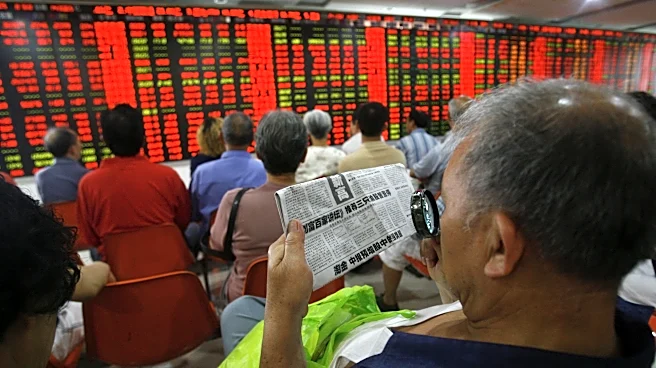
increased research and collaboration among regulators to address unpredictable elements and enhance resilience against 'black swan' and 'gray rhino' events. His recommendations include a deeper examination of global market cycles, evolving valuations, and the cross-border movement of risks across various markets and industries. He also highlighted China's unique market characteristics, with over 200 million stock investors and 800 million fund holders, suggesting that China should learn from mature economies while acknowledging its distinct structural challenges.
Why It's Important?
This warning from a prominent China regulator carries significant implications for global financial markets, including those in the U.S. A global market repricing and portfolio rebalancing could lead to substantial shifts in capital flows, affecting U.S. investments, asset valuations, and economic stability. Geopolitical tensions and uncertain policy paths, as cited by Wu, directly impact investor confidence and risk assessment, potentially leading to increased volatility in U.S. stock markets and bond yields. The call for greater regulatory cooperation underscores the interconnectedness of global finance, where events in one major economy can have ripple effects worldwide. U.S. investors and policymakers will need to closely monitor these global shifts to anticipate potential impacts on domestic markets, corporate earnings, and overall economic growth. The emphasis on resilience against 'black swan' and 'gray rhino' events suggests a heightened awareness of systemic risks that could originate from various global sources.
What's Next?
Wu Qing urged Chinese authorities to consider long-term mechanisms to stabilize capital markets and control abnormal volatility. This includes exploring improvements to regulations concerning quantitative trading and reductions in shareholdings, as well as implementing 'fair and reasonable' regulatory arrangements to mitigate swings caused by herd behavior and short-term trading. Furthermore, Wu called for deeper inquiry into how artificial intelligence (AI) might influence asset pricing and information reporting in capital markets. This research should also address issues such as liability, data protection, systemic risk, opaque algorithms, AI-linked cyberattacks, and the robustness of financial infrastructure. These discussions and potential regulatory changes in China could set precedents or influence global best practices, impacting how U.S. financial institutions and tech companies operate in an increasingly interconnected and AI-driven financial landscape.
Beyond the Headlines
The regulator's comments extend beyond immediate market concerns, touching upon the ethical and structural implications of advanced technologies like AI in finance. The call for research into AI's impact on asset pricing, data protection, and systemic risk highlights a growing global concern about the unchecked influence of algorithms and automation in financial markets. This could lead to international dialogues and potential regulatory frameworks that address the unique challenges posed by AI, such as algorithmic bias, market manipulation, and the potential for AI-driven flash crashes. For the U.S., this implies a need for proactive engagement in developing robust regulatory responses to AI in finance, ensuring market integrity and investor protection. The emphasis on learning from mature economies while acknowledging unique market features also suggests a nuanced approach to global financial governance, where collaboration is balanced with national interests and specific market conditions.