

What's Happening?
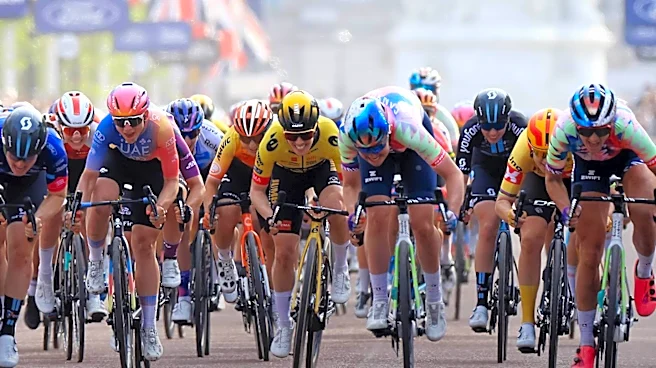
Lorena Wiebes of SD Worx-Protime has claimed her third stage win in four days at the Tour of Britain Women, triumphing in a sprint finish on stage 4 in Hay-on-Wye. Wiebes outpaced Liane Lippert (Movistar) and race leader Kim Le Court-Pienaar (AG Insurance-Soudal)
after a challenging 138.3km stage through the Welsh hills, which included nearly 2,000 meters of elevation. This victory highlights Wiebes's growing strength on varied terrain, as she successfully navigated numerous general classification attacks over the final categorized climbs. Her performance suggests an evolution beyond her renowned sprinting prowess, with previous strong showings at races like Amstel Gold Race and an uphill finish at the Tour de France Femmes. Wiebes expressed her ambition to further develop her climbing abilities while maintaining her sprint power, indicating a strategic shift towards becoming a more versatile rider capable of competing in hilly classics.
Why It's Important?
Wiebes's continued dominance and demonstrated adaptability are significant for women's professional cycling. Her ability to win on diverse terrains, including hilly stages, challenges the traditional categorization of riders solely as sprinters or climbers. This evolution could inspire other riders to develop a broader skill set, leading to more dynamic and unpredictable race outcomes. For teams, having riders like Wiebes who can perform across different profiles offers strategic advantages, allowing for greater flexibility in race tactics and increased chances of victory in various types of events. Her success also elevates the profile of the Tour of Britain Women, drawing more attention to the competitive nature and growing talent within the sport. Furthermore, her stated goal of targeting races like Amstel Gold Race signals a potential shift in the competitive landscape of the Ardennes classics, where her sprint power combined with improved climbing could make her a formidable contender.
What's Next?
Lorena Wiebes will have another opportunity to secure a stage victory in the Tour of Britain Women's finale in Leamington Spa. Given the largely flat profile of the final stage, she is considered the overwhelming favorite to win, which could mark her fourth stage triumph of the event. Beyond the immediate race, Wiebes aims to surpass Liane Lippert in the general classification to secure second place overall, although the overall title remains out of reach with Kim Le Court-Pienaar holding a significant lead. Looking further ahead, Wiebes's stated ambition to develop her climbing skills suggests she will continue to target hillier races and classics in future seasons, potentially including the Amstel Gold Race. Her ongoing development will be closely watched as she seeks to balance her top-end sprint power with enhanced climbing capabilities, aiming for success in a wider range of prestigious events.
Beyond the Headlines
Lorena Wiebes's strategic evolution from a pure sprinter to a more versatile rider capable of excelling in hilly terrain reflects a broader trend in professional cycling where athletes are increasingly seeking to broaden their skill sets. This shift is driven by the evolving demands of modern race courses, which often feature varied topography designed to challenge specialists. Her ambition to develop in the hills while retaining her sprint power highlights the pursuit of a 'sprinter-puncheur' archetype, a valuable asset in races with undulating profiles and uphill finishes. This development could influence training methodologies and talent identification within women's cycling, encouraging younger riders to cultivate a more all-around ability rather than specializing too early. Ethically, it underscores the dedication and continuous self-improvement required at the elite level, pushing the boundaries of what is considered possible for a sprinter. Culturally, Wiebes's pursuit of new challenges adds another compelling narrative to the sport, showcasing athletes' desire for growth and mastery beyond their established strengths.