





What's Happening?
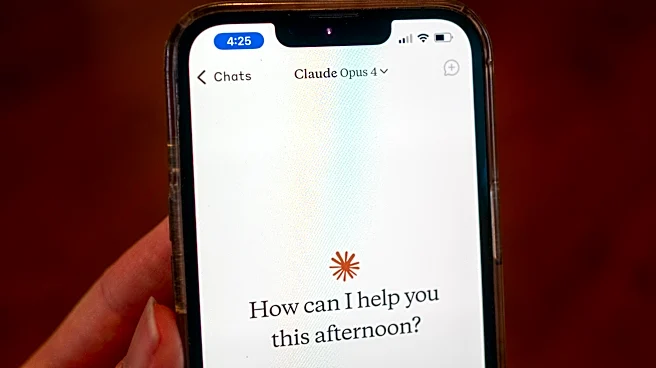
Anthropic has initiated payments to authors as part of its $1.5 billion settlement in the Bartz v. Anthropic class-action lawsuit. This case was brought by authors whose books were used without permission to train Anthropic's AI model, Claude. The initial
payment constitutes approximately 70 percent of the total amount for undisputed claims, equating to about $2,203.56 per work. Novelist Courtney Milan has confirmed receipt of her share, and the Authors Guild reports that payments for undisputed claims are being processed in the week of November 23, 2026. This marks the first instance of a major AI company compensating writers for books utilized in training its models. The remaining 30 percent of the settlement is anticipated after Anthropic deposits an additional $450 million, a payment tied to an IPO or significant investment, with September 2027 as the latest date. The Authors Guild expects this balance to be distributed quickly following Anthropic's recent IPO.
Why It's Important?
This settlement establishes a significant precedent for intellectual property rights in the age of artificial intelligence, particularly concerning the use of copyrighted material for training AI models. The payment by Anthropic signals a potential shift in how AI companies approach data acquisition, moving towards compensation rather than uncompensated use. For authors, this settlement validates their claims of ownership over their creative works and underscores the financial value of their contributions to AI development. It also highlights the importance of clear ownership records and contracts, as authors with well-documented rights are receiving payments first. The outcome could influence ongoing and future lawsuits against other AI companies, potentially leading to similar settlements and a more structured compensation framework for creators across various media, including screenwriters, whose works may also be used for AI training.
What's Next?
The remaining 30 percent of the settlement, approximately $450 million, is expected to be distributed soon after Anthropic deposits the funds, following its recent IPO. The Authors Guild anticipates a swift distribution once the funds are secured. For claims that are currently disputed, typically due to differing declarations of shares between authors and publishers, resolution will either occur through direct agreement between parties or via a court-appointed special master. This process will determine the rightful recipients and their respective shares. The precedent set by this settlement is likely to influence future negotiations between creators and AI companies, potentially establishing a baseline for compensation for the use of copyrighted works in AI training. Screenwriters, in particular, are advised to monitor these developments closely, as similar questions regarding their intellectual property and AI training are expected to arise.
Beyond the Headlines
The Anthropic settlement extends beyond immediate financial compensation, raising profound questions about the ethical and legal frameworks governing AI development and intellectual property. It underscores the growing tension between technological innovation and creators' rights, highlighting the need for robust legal protections in the digital age. The emphasis on clear ownership records and contracts for authors reveals a critical lesson for all creators: meticulous documentation of rights is paramount in an evolving landscape where digital assets can be easily replicated and utilized. This case could catalyze broader discussions about fair use, copyright infringement, and the economic models that will sustain creative industries in an AI-driven future. It also prompts a re-evaluation of existing contracts to include specific clauses addressing AI training, ensuring creators are adequately compensated for the value their work provides to advanced technologies.