







What's Happening?
Daniele Pucci, CEO of Generative Bionics, outlined his company's approach to developing humanoid robots, emphasizing human-robot integration rather than replacement. Pucci highlighted that Generative Bionics aims to amplify human capabilities, particularly
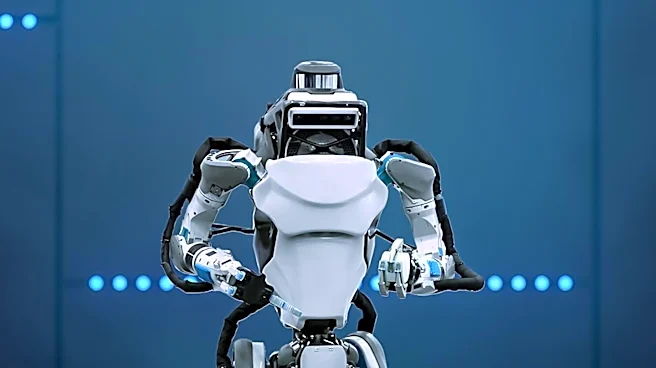
in physically demanding roles, by designing robots that work alongside people. He noted that the company's humanoid robot, Gene.01, features whole-body tactile sensors and proximity sensors, allowing it to 'feel' and anticipate touch, which is crucial for safe human interaction. This design philosophy stems from the belief that robots interacting with humans must have a sense of touch, similar to how doctors use sensors for diagnosis. Pucci also discussed the evolution of humanoid robotics, noting that advancements in mechatronics and motor efficiency in the 2020s significantly accelerated the field, enabling robots to perform complex movements like jumping and dancing. He stressed that the body and AI are inseparable, advocating for the concept of 'body as compute' in robot design.
Why It's Important?
This development is significant for the future of labor and industrial applications in the U.S. and globally. Generative Bionics' focus on human-robot integration offers a potential solution to concerns about job displacement due to automation, instead proposing a model where robots enhance worker safety and efficiency. By addressing musculoskeletal diseases, particularly in manual labor and healthcare, these robots could lead to a healthier workforce and reduced healthcare costs. The emphasis on safety and regulatory compliance from the outset, driven by European standards, could set a higher bar for robot deployment, potentially influencing U.S. regulatory frameworks as well. The company's strategy of developing a common platform (Gene.01) for application-specific robots allows for versatility while maintaining a focus on solving concrete problems in areas like logistics, manufacturing, and healthcare, thereby accelerating the practical adoption of humanoid robotics in various U.S. industries.
What's Next?
Generative Bionics plans to continue developing its Gene.01 platform to create application-specific humanoid robots for various industries. The company aims to scale globally, leveraging its experience with European regulations to influence international safety standards for human-robot integration. Future applications are expected in areas such as surveillance, patrolling, logistics, manufacturing, and healthcare. In healthcare, the initial focus will be on roles further from direct patient physical assistance, such as guiding patients in hospitals or assisting with micro-logistics, before gradually moving towards more intimate physical assistance like neurorehabilitation. The company is actively working on compliance and safety certifications to ensure the safe deployment of its robots in environments shared with humans, indicating a push for new regulatory frameworks and industry standards.
Beyond the Headlines
The approach taken by Generative Bionics highlights a deeper philosophical shift in robotics: moving from human replacement to human amplification. This perspective could reshape public perception of AI and automation, fostering greater acceptance and trust. The integration of advanced tactile and proximity sensors in robots like Gene.01 raises ethical considerations regarding the nature of human-robot interaction and the boundaries of artificial 'feeling.' Furthermore, the company's commitment to developing robots that can 'feel' and anticipate human needs could lead to more empathetic and responsive AI systems, potentially influencing the design of future technologies beyond robotics. The ongoing evolution of regulatory frameworks to accommodate human-robot integration will also be a critical area, as it will define the legal and ethical landscape for these advanced technologies.