




What's Happening?
Morgan Stanley has issued its most optimistic near-term outlook for U.S. stocks since April, asserting that the recent market sell-off presents significant buying opportunities. According to a team led by chief U.S. equity strategist Mike Wilson, the market decline
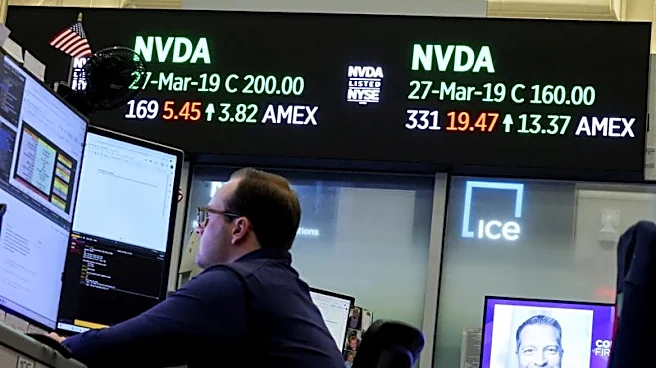
was 'too deep' and not reflective of a worsening in fundamental business conditions. The bank's analysis suggests that current stock prices are factoring in a 6% decrease in corporate earnings for 2027. This contrasts sharply with Morgan Stanley's own forecast of a 14% increase in earnings and Wall Street's average estimate of a 17% rise. The recent market slump was attributed to concerns over artificial intelligence spending, elevated valuations, and political unpredictability. However, major tech stocks like Nvidia, Alphabet, and Meta Platforms saw significant gains in premarket trading following the sell-off. Morgan Stanley also expressed skepticism regarding predictions of further interest rate hikes from the Federal Reserve, arguing that existing tighter financial conditions have already impacted markets.
Why It's Important?
This positive stance from Morgan Stanley is significant because it challenges prevailing market sentiment and could influence investor behavior. If Morgan Stanley's forecast of 14% earnings growth proves accurate, it suggests that current stock valuations are undervalued, presenting a potential upside for investors who buy into the market now. This perspective could encourage a shift in investment strategies, particularly towards sectors identified as potential beneficiaries, such as cloud computing companies, quality cyclical stocks, and industrial industries. Furthermore, Morgan Stanley's questioning of future Federal Reserve rate hikes could alleviate some market anxiety. If the Fed indeed holds off on further increases, it could provide a more stable economic environment, potentially boosting corporate profitability and investor confidence. Conversely, if the market's more pessimistic earnings outlook materializes, investors following Morgan Stanley's advice could face losses, highlighting the inherent risks in differing market analyses.
What's Next?
Investors will closely monitor upcoming economic reports, statements from Federal Reserve policymakers, and corporate earnings predictions to gauge the sustainability of any market rebound. The performance of key sectors, particularly cloud computing and industrial stocks, will be a critical indicator of whether Morgan Stanley's predictions are gaining traction. Should economic data align with Morgan Stanley's more optimistic view, a broader market recovery could ensue, potentially leading to increased capital allocation into equities. Conversely, any signs of continued economic weakness or hawkish signals from the Federal Reserve could reinforce the market's current cautious stance. The market will also be watching how major tech companies like Nvidia, Alphabet, and Meta Platforms continue to perform, as their resilience could signal broader market strength despite previous concerns about AI spending and valuations. Traders are currently anticipating at least two rate hikes by March 2027, according to LSEG data, making the Fed's future communications particularly impactful.
Beyond the Headlines
Morgan Stanley's contrarian view highlights a fundamental tension in financial markets: the divergence between institutional analysis and broader investor sentiment. This situation often arises from differing interpretations of economic indicators, corporate fundamentals, and future policy actions. The bank's call could be seen as an attempt to re-anchor market expectations to underlying business strength rather than speculative fears. This divergence also underscores the influence of major financial institutions in shaping market narratives and investor confidence. If Morgan Stanley's outlook gains traction, it could lead to a re-evaluation of risk premiums and growth prospects across various sectors. The debate over future interest rate hikes also touches upon the broader economic philosophy of central banks – balancing inflation control with economic growth. The outcome of this debate will have long-term implications for capital allocation, corporate investment, and overall economic stability.