

What's Happening?
The Office of the United States Trade Representative (USTR) has initiated the Rapid Response Labor Mechanism (RRM) under the United States-Mexico-Canada Agreement (USMCA) to investigate alleged denials of freedom of association and collective bargaining
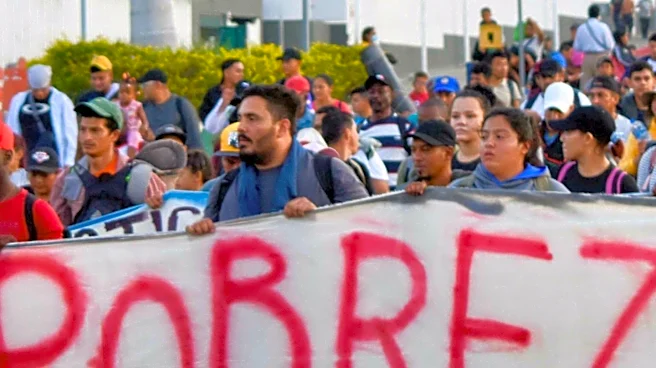
rights at Industrias FG, S.A. de C.V. in Morelos, Mexico. This action follows a petition filed on October 13, 2026, by the Sindicato Nacional de Trabajadoras y Trabajadores de Industrias y Servicios “Ricardo Flores Magón,” a Mexican labor union. The union alleges that Industrias FG coerced workers to support a company-favored union, refused to bargain with the authorized union, discriminated against union-active workers through retaliatory dismissals, and interfered with union activities via interrogations, harassment, threats, and misinformation. The Interagency Labor Committee for Monitoring and Enforcement (ILC), co-chaired by the USTR and the Secretary of Labor, reviewed the petition and found sufficient credible evidence to invoke the RRM. Consequently, the USTR has requested Mexico to review the situation and has directed the Secretary of the Treasury to suspend the liquidation of unliquidated entries of goods from Industrias FG, which manufactures polyurethane hydraulic seals.
Why It's Important?
This invocation of the USMCA's Rapid Response Labor Mechanism underscores the U.S. government's commitment to enforcing labor provisions within its trade agreements. It signals to companies operating in USMCA countries that violations of workers' rights, particularly freedom of association and collective bargaining, will face scrutiny and potential trade consequences. For U.S. businesses, this action highlights the importance of supply chain due diligence and ensuring that their international partners adhere to fair labor practices. The suspension of liquidation of goods from Industrias FG could disrupt supply chains for U.S. industries relying on these polyurethane hydraulic seals, potentially leading to increased costs or sourcing challenges. This move also reinforces the role of labor unions in both the U.S. and Mexico in advocating for workers' rights and utilizing international trade mechanisms to achieve their objectives. The outcome of Mexico's review will set a precedent for future labor disputes under the USMCA, influencing labor relations and trade practices across the North American continent.
What's Next?
Mexico has a 10-day period to agree to conduct a review of the alleged labor rights denials at Industrias FG. If Mexico agrees, it then has 45 days from the date of the USTR's request to complete its review. The findings of this review will determine the subsequent steps. Should Mexico's review confirm the allegations, or if Mexico fails to conduct an adequate review, further enforcement actions could be considered under the USMCA. These could include additional trade penalties or other measures aimed at ensuring compliance with labor standards. The U.S. government, through the USTR and the Interagency Labor Committee, will closely monitor Mexico's response and the progress of the investigation. This case will serve as a test of the effectiveness of the USMCA's labor enforcement mechanisms and could influence how similar disputes are handled in the future.
Beyond the Headlines
The USTR's action extends beyond a simple trade dispute, touching upon the broader ethical and social responsibilities of multinational corporations and the role of trade agreements in promoting human rights. The focus on freedom of association and collective bargaining reflects a growing international emphasis on workers' empowerment and fair labor conditions as integral components of sustainable trade. This case could encourage greater transparency and accountability in global supply chains, prompting companies to proactively assess and mitigate labor risks in their operations abroad. Furthermore, it highlights the evolving nature of trade policy, where economic considerations are increasingly intertwined with social and environmental concerns. The successful enforcement of these labor provisions could strengthen the credibility of the USMCA as a model for future trade agreements, demonstrating that trade liberalization can be pursued in conjunction with robust protections for workers.