






What's Happening?
The White House's Office of Trade and Manufacturing Policy has released a report titled 'The Great Transshipment Scam,' accusing China and 40 other economies, including Myanmar, of participating in a 'shadow transshipment network.' This network allegedly
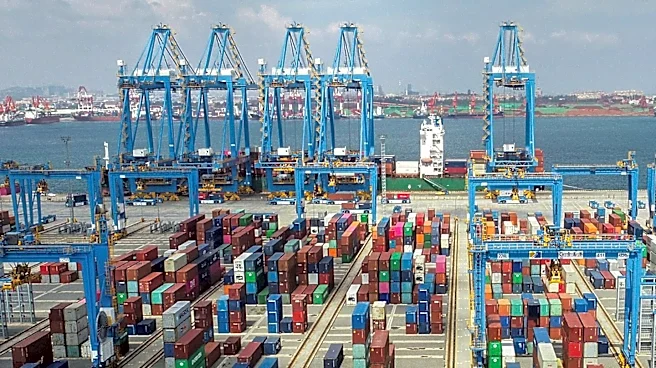
funnels Chinese-made goods to the U.S. while obscuring their true country of origin. The report claims this illegal rerouting has cost the U.S. as much as $303 billion. Transshipment, as defined by the Center for Strategic and International Studies, involves moving items from one country to another with an intermediate stop that changes the good's country of origin. The White House's concern lies with instances where little to no value is added during the intermediate stop, essentially relabeling or repackaging goods to circumvent tariffs. The 40 economies are categorized into three tiers, with Myanmar falling into Tier 3, labeled as 'small, opportunistic Chinese targets' with 'specific weak-link advantages' like low-cost labor and free zones. Other countries in this tier include Singapore and the Philippines.
Why It's Important?
This report highlights a significant economic and trade challenge for the U.S., as the alleged 'Great Transshipment Scam' is claimed to have displaced 450,000 American jobs, reduced annual GDP by $113 billion to $150 billion, and resulted in federal revenue losses between $19 billion and $26 billion. The U.S. government views these activities as illegal attempts to secure tariff treatment that would not apply if the goods' true economic origin were declared. The inclusion of countries like Myanmar, Singapore, and EU nations in the report indicates a broad scope of concern, potentially impacting international trade relations and supply chain practices globally. The U.S. is signaling increased scrutiny on major transshipment hubs, not just manufacturing centers, which could lead to heightened compliance pressures for businesses operating in these regions. The report underscores the ongoing trade tensions between the U.S. and China and the complexities of global supply chains in an era of tariffs and trade disputes.
What's Next?
While the White House report did not specify immediate actions against China or the other named economies, it did announce plans to develop an 'AI-enabled detective border.' This system will ingest and analyze global trade data to identify illicit transshipment activities, indicating a technological approach to enforcement. The U.S. is applying pressure by publicly naming these economies, which analysts suggest is a form of leverage. Major stakeholders, including China, the European Union, and Singapore, have already pushed back against the report's accusations. A Chinese embassy spokesperson stated firm opposition to the suppression of Chinese enterprises and warned of steps to safeguard its interests. The EU and Singapore have also reiterated their commitment to trade compliance while asserting their regulatory autonomy. This suggests a period of diplomatic and economic maneuvering, with potential for increased trade investigations, stricter customs enforcement, and possibly new trade policies or sanctions if the U.S. decides to take further action based on its findings.
Beyond the Headlines
The 'Great Transshipment Scam' report delves into the intricate and often opaque world of global trade, where the origin of goods can be deliberately obscured for economic advantage. Beyond the immediate financial implications, this issue raises ethical and legal questions about fair trade practices and the integrity of international commerce. The report's focus on 'relabeling, repackaging, re-invoicing, minor processing, false country-of-origin claims' highlights the sophisticated methods used to circumvent trade regulations. The U.S. emphasis on an 'AI-enabled detective border' signifies a growing reliance on advanced technology to combat complex economic crimes, potentially setting a precedent for future trade enforcement. This development could lead to a re-evaluation of supply chain transparency and corporate responsibility, pushing companies to ensure the ethical sourcing and accurate labeling of their products. The broader implication is a potential shift towards more stringent global trade compliance, impacting businesses worldwide and potentially reshaping international trade agreements.