


What's Happening?
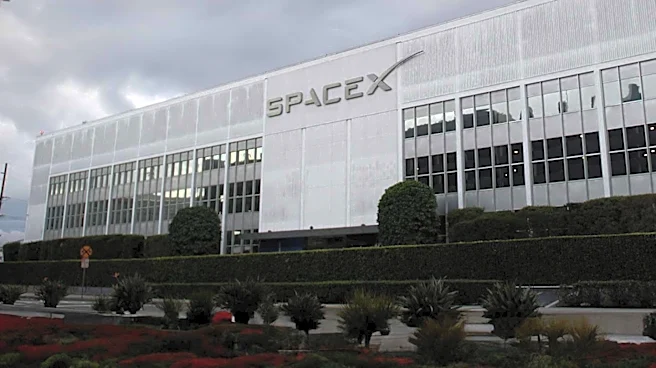
SpaceX has announced plans to build a massive Terafab facility in Grimes County, Texas, which could become the largest building on Earth. The facility, stretching 2.5 miles in length, aims to consolidate all stages of semiconductor production under one
roof. This includes fabrication, packaging, and final testing, with outputs intended for Tesla's Optimus humanoid robots and Cybercab vehicles, as well as SpaceX's orbital data center infrastructure. The project, with an initial investment of $16.8 billion, is expected to create thousands of jobs and significantly boost local and national semiconductor production capacity.
Why It's Important?
The Terafab facility represents a strategic move by SpaceX to address semiconductor shortages that have impacted global supply chains, particularly during the COVID-19 pandemic. By consolidating semiconductor production domestically, SpaceX aims to meet the high compute capacity demands of its operations and those of Tesla. This development is crucial for the U.S. semiconductor industry, as it enhances domestic production capabilities and reduces reliance on international supply chains. The project is also expected to create significant economic opportunities in Texas, contributing to job creation and regional economic growth.
What's Next?
SpaceX plans to begin early production at the Terafab facility as soon as next year, with mass production targeted for 2028. The project has received support from Texas Governor Greg Abbott, who announced a $30 million Texas Enterprise Fund grant to SpaceX. The facility also qualifies for state-backed tax incentives under Texas's JETI program. As construction progresses, stakeholders will be watching closely to see if SpaceX can meet its ambitious production timeline and investment commitments. The project's success could set a precedent for future large-scale semiconductor manufacturing initiatives in the U.S.