







What's Happening?
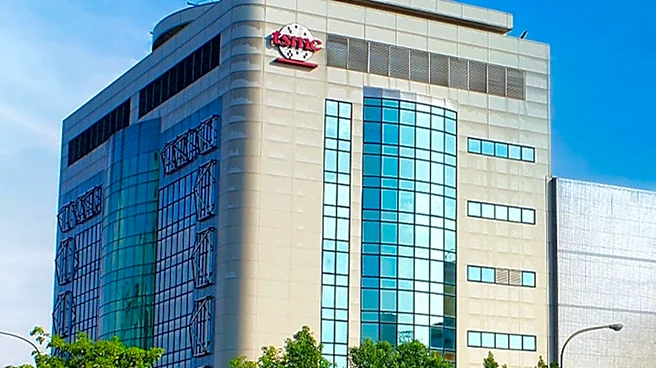
The European Semiconductor Manufacturing Company (ESMC) has celebrated the topping-out ceremony for its new microchip factory in Dresden, Germany, marking the completion of the building's shell. This joint venture involves Taiwanese industry giant TSMC,
holding a 70 percent stake, along with Bosch, Infineon, and NXP Semiconductor, each holding 10 percent. The total investment for the project is ten billion euros, with the Federal Ministry for Economic Affairs contributing five billion euros as a grant. Production at the facility is scheduled to commence in 2027, focusing primarily on chips for the automotive industry. The project is expected to create 2,000 jobs, further solidifying Dresden's position as 'Silicon Saxony,' Europe's largest microelectronics hub.
Why It's Important?
While located in Germany, the ESMC microchip factory has significant implications for the global semiconductor supply chain, including the U.S. The U.S. automotive industry, like many others, relies heavily on a stable supply of semiconductors. The increased production capacity, particularly for automotive chips, could help alleviate future supply chain disruptions that have previously impacted U.S. car manufacturers. Furthermore, the involvement of TSMC, a major global chip manufacturer, in a European venture highlights the ongoing efforts to diversify and strengthen semiconductor manufacturing capabilities outside of traditional Asian hubs. This diversification can contribute to greater resilience in the global supply chain, indirectly benefiting U.S. industries by ensuring a more robust and geographically distributed source of critical components. The creation of 2,000 jobs in a high-tech sector also underscores the economic impact of such investments.
What's Next?
Following the topping-out ceremony, the next phase for the ESMC microchip factory will involve the installation and qualification of production equipment within the completed building shell. Production is slated to begin in 2027, with a primary focus on manufacturing chips for the automotive sector. The continued growth of 'Silicon Saxony' is anticipated, with the Ministry of Economic Affairs projecting an increase in employees from 80,000 to around 100,000 by 2040, driven by TSMC's arrival and expansions by other companies like Infineon and Globalfoundries. This expansion will further integrate Dresden into the global semiconductor ecosystem, potentially attracting more related businesses and fostering technological advancements in the region.
Beyond the Headlines
The ESMC factory in Dresden represents a broader strategic effort by European nations to enhance their semiconductor independence and reduce reliance on foreign supply chains, a sentiment echoed in the U.S. with initiatives like the CHIPS Act. This move towards regional self-sufficiency in critical technologies has geopolitical implications, as it aims to secure essential components for key industries like automotive and defense. The substantial government grant from the Federal Ministry for Economic Affairs underscores the strategic importance placed on semiconductor manufacturing by national governments. This trend of reshoring or 'friend-shoring' critical manufacturing capabilities could lead to a more fragmented but potentially more resilient global supply chain, impacting international trade dynamics and technological partnerships in the long run. The focus on automotive chips also highlights the increasing digitalization of traditional industries and their growing dependence on advanced semiconductor technology.