


What's Happening?
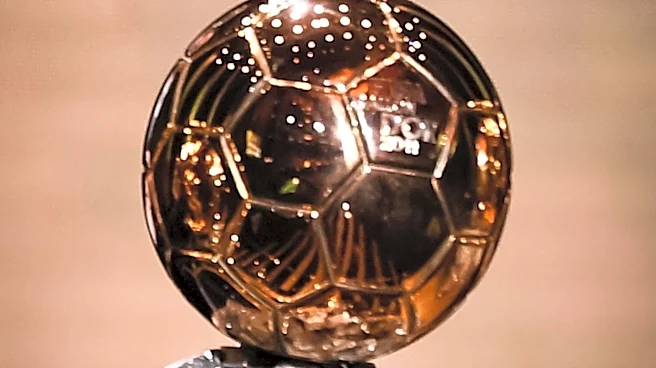
The Super Ballon d'Or, a distinct and rare football award, has been presented only once in history. On December 24, 1989, France Football awarded this special honor to Alfredo Di Stéfano, recognizing his extraordinary career and historical influence on the
sport. Di Stéfano, a Real Madrid legend who had previously won the regular Ballon d'Or twice, was chosen over other football greats like Johan Cruyff and Michel Platini in the final vote. Unlike the annual Ballon d'Or, which celebrates the best player of a single year, the Super Ballon d'Or was a one-off recognition of a player's overall body of work, longevity, and transformational impact across multiple decades and continents. France Football has not established a regular schedule for this award, making Di Stéfano its sole recipient.
Why It's Important?
The Super Ballon d'Or's singular nature underscores the exceptional historical significance attributed to Alfredo Di Stéfano's career. It highlights a recognition beyond annual performance, focusing instead on a player's enduring legacy and foundational impact on the sport. This distinction is important because it acknowledges that some players transcend typical statistical measures and annual comparisons, shaping the very structure and evolution of football. The award's rarity also emphasizes the difficulty of achieving such a profound and lasting influence that warrants a unique, non-recurring honor. For football history, it serves as a benchmark for evaluating the most transformative figures, setting Di Stéfano apart even from other multi-Ballon d'Or winners like Lionel Messi and Cristiano Ronaldo, who have not received this particular accolade.
What's Next?
As the Super Ballon d'Or was a one-time award presented in 1989, there are no foreseeable next steps or scheduled decisions regarding its future. France Football has not announced any plans for another edition, and it remains a unique historical certificate rather than an ongoing competition. Any future presentation of such an award would require an explicit announcement and a re-evaluation of its criteria by France Football. Given its historical context and the specific intent behind its original presentation, it is unlikely to be revived unless there is a consensus within the football community to recognize another player with a similarly unparalleled and transformative career spanning multiple eras.
Beyond the Headlines
The Super Ballon d'Or's existence as a one-off award prompts deeper reflection on how greatness is defined and celebrated in sports. It suggests that while annual awards capture peak performance, there's a separate category for individuals whose careers fundamentally alter the sport's trajectory. This distinction raises questions about the criteria for 'transformational influence' versus 'best player of the year' and how these different forms of impact are valued. The award also highlights the subjective nature of historical recognition, as the panel in 1989 chose Di Stéfano over other legends, emphasizing his role as a bridge between eras and his influence on the development of European football. It serves as a reminder that some achievements are so monumental they defy regular categorization, standing as singular markers in the annals of sports history.