





What's Happening?
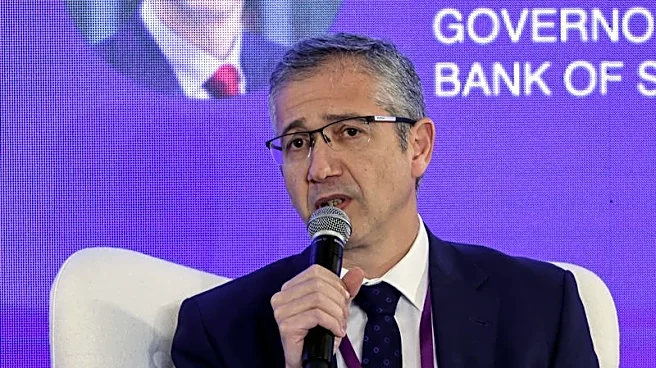
The European Council has nominated Pablo Hernández de Cos, currently the general manager of the Bank for International Settlements (BIS), to serve as the next president of the European Central Bank (ECB). He is expected to replace Christine Lagarde on February
7, 2027, pending consultations with the European Parliament and the ECB Governing Council. Hernández de Cos is known for his skepticism regarding stablecoins as a credible large-scale payment instrument and his advocacy for tokenized commercial bank deposits. At the Jackson Hole Economic Symposium in August, he articulated his view that tokenized deposits offer advantages such as programmability, atomic settlements, and 24/7 operations. He also expressed concerns that widespread use of dollar-backed stablecoins outside the U.S. could weaken countries' monetary policy control and divert deposits from traditional banks. His nomination suggests a continued cautious approach by the ECB towards private digital tokens.
Why It's Important?
Hernández de Cos's stance on digital currencies could significantly influence the future of digital finance within the euro area and potentially impact global financial markets. His preference for tokenized commercial bank deposits over stablecoins highlights a regulatory inclination towards integrating blockchain technology within existing banking structures, rather than embracing decentralized alternatives. This approach could lead to increased scrutiny and stricter regulations for stablecoins, potentially limiting their adoption and utility in the U.S. and international markets. For U.S. financial institutions and technology companies involved in stablecoin development or blockchain solutions, this signals a need to understand and adapt to evolving European regulatory frameworks. The emphasis on tokenized deposits could also spur innovation in traditional banking, encouraging U.S. banks to explore similar models for on-chain settlements and cross-border payments, potentially fostering new partnerships and competitive landscapes.
What's Next?
The nomination of Pablo Hernández de Cos requires further consultations with the European Parliament and the ECB Governing Council before a formal decision is made in December. If confirmed, he will assume the ECB presidency for an eight-year, non-renewable term starting February 7, 2027. His leadership is expected to shape the ECB's approach to digital money, including the ongoing development of a digital euro. The ECB plans to commence a digital euro pilot in the second half of 2027, with potential issuance as early as 2029, contingent on the adoption of necessary legislation. This timeline suggests that the policy direction under Hernández de Cos will directly influence the design and implementation of the digital euro, potentially setting precedents for other central banks, including the U.S. Federal Reserve, as they consider their own digital currency initiatives.
Beyond the Headlines
The debate between stablecoins and tokenized bank deposits, as highlighted by Hernández de Cos, touches upon fundamental questions about monetary sovereignty, financial stability, and the role of commercial banks in a digital economy. His concerns about 'digital dollarization' due to dollar-backed stablecoins underscore a broader geopolitical tension regarding currency dominance and the potential erosion of national monetary control. For the U.S., this perspective from a key European financial leader could influence discussions around the regulation of stablecoins and the potential implications for the dollar's international standing. Furthermore, his past role in chairing the Basel Committee on Banking Supervision, which imposed a 1250% risk weight on banks' direct holdings of high-risk crypto assets like Bitcoin, indicates a consistent regulatory philosophy that prioritizes financial stability and traditional banking safeguards over speculative digital asset exposure. This approach could lead to a more conservative global regulatory environment for cryptocurrencies, impacting their integration into mainstream finance.