
What's Happening?
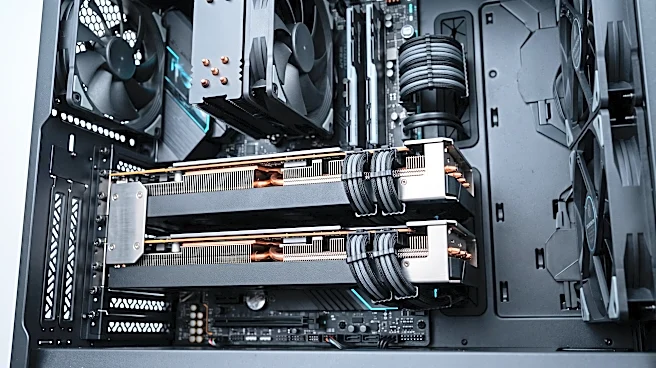
Users with two NVIDIA RTX PRO 6000 Blackwell Workstation Edition GPUs running Windows 11 build 28000.3501 and Ubuntu 24.04 under WSL2 are reporting a potential driver regression with NVIDIA driver version
621.40. Previously, with drivers 610.88 and 616.92, WSL CUDA successfully enumerated both GPUs, allowing CUDA kernels on each GPU to read and write the other GPU’s memory. However, with driver 621.40, while Windows CUDA still detects both GPUs and passes peer tests, WSL CUDA's `cuDeviceGetCount` function returns 1, making only one GPU visible. Disabling the GPU link with driver 621.40 allows WSL CUDA to see both GPUs again, but bidirectional CUDA peer access becomes unavailable. This issue was observed with NVIDIA Mosaic and reproduced with a linked topology configured by a NativeSLI test tool.
Why It's Important?
This driver regression significantly impacts developers and researchers utilizing multi-GPU setups for high-performance computing tasks within the Windows Subsystem for Linux (WSL2) environment. The inability to detect and utilize both GPUs simultaneously in WSL2 with driver 621.40 means a substantial reduction in available computational power for CUDA-accelerated applications. This could lead to slower processing times, increased development costs due to inefficient hardware utilization, and potential delays in projects relying on distributed GPU computing. For professionals in fields like AI, machine learning, and scientific simulations, where multi-GPU performance is critical, this issue could force them to revert to older, potentially less secure or feature-rich drivers, or seek alternative computing environments, impacting productivity and innovation.
What's Next?
The user has raised this issue on NVIDIA developer forums, seeking confirmation from the Windows driver or CUDA on WSL team regarding whether this change is expected. They are also inquiring about a supported configuration or a driver update that could restore both GPU enumeration and bidirectional CUDA peer access in WSL while the GPUs remain linked. The next steps would likely involve NVIDIA investigating this reported regression and potentially releasing a patch or a new driver version that addresses the multi-GPU detection and peer access issues in WSL2 for RTX PRO 6000 Blackwell GPUs. Users affected by this issue will be closely monitoring NVIDIA's response and subsequent driver releases.
Beyond the Headlines
This incident highlights the complex interplay between hardware, operating systems, and driver software, particularly in specialized computing environments like WSL2. The discrepancy in GPU detection between Windows CUDA and WSL CUDA, despite the same underlying hardware and driver, points to potential integration challenges or specific optimizations within the WSL environment that are sensitive to driver updates. It also underscores the importance of thorough testing across various configurations before rolling out new driver versions, especially for professional-grade hardware. Such regressions can erode user confidence and create significant workflow disruptions, emphasizing the need for robust compatibility and backward-compatibility considerations in driver development for advanced computing platforms.