





What's Happening?
A consortium led by Novacium, in collaboration with AxelOne and AD-VENTA, has secured funding from France's Defence Innovation Agency and the Directorate General for Armaments under the RAPID program. This funding, totaling nearly EUR1 million, will support
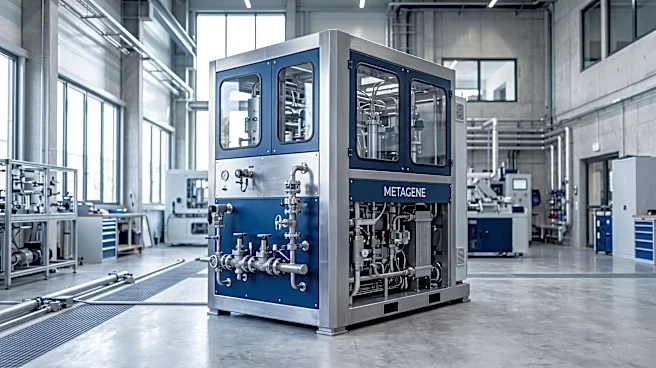
the METAGENE project, which aims to develop and validate a self-contained, high-pressure green hydrogen production station. The METAGENE project, which began on September 1, 2026, is a 30-month effort designed to advance the technology from Technology Readiness Level 3 to TRL 5-6. The patented METAGENE process produces green hydrogen without electricity, using a solid metallic fuel based on aluminum and silicon that releases hydrogen upon contact with water. This method generates no greenhouse gases and leaves an inert solid by-product, simplifying transport and storage due to the non-hazardous nature of the solid fuel.
Why It's Important?
This development is significant for the green hydrogen market, particularly in its potential to decentralize hydrogen production. By enabling on-site hydrogen generation without electricity or extensive infrastructure, the METAGENE project addresses key challenges associated with the transportation and storage of pressurized hydrogen, which can be costly and complex. The technology's ability to produce hydrogen at the point of use could reduce operational expenses, as the raw material cost is estimated at EUR20 to EUR30 per kilogram of hydrogen produced on site, compared to over EUR50 per kilogram for transported hydrogen. This innovation could accelerate the adoption of green hydrogen in various sectors, including mobility and defense, by offering a more accessible and cost-effective solution.
What's Next?
The RAPID funding will specifically support the development and validation of a high-pressure dispensing station capable of delivering up to 20 kilograms of hydrogen per day, integrating Novacium's METAGENE reactor. The 30-month project timeline, which commenced in September 2026, indicates that significant progress in validating the technology under real-world conditions is expected by early 2029. Successful validation could pave the way for broader commercialization and deployment of this green hydrogen production method. The consortium's existing industrial partnerships, including a memorandum of understanding with GLD Alloys for low-carbon aluminum supply and an agreement with AD-VENTA for dispensing station integration, suggest a clear path toward market entry and scaling up production.
Beyond the Headlines
The METAGENE project's focus on a self-contained, electricity-free green hydrogen production method has broader implications for energy independence and security. Its dual-use potential, serving both civilian and military applications, highlights its strategic value. The technology's reliance on a solid metallic fuel that is inert and non-hazardous could mitigate safety concerns associated with traditional hydrogen storage and transport, potentially accelerating its adoption in sensitive environments. Furthermore, the project's contribution to the circular economy by utilizing aluminum and silicon-based fuel, which leaves an inert solid by-product, aligns with global sustainability goals and could inspire similar innovations in resource-efficient energy production.