


What's Happening?
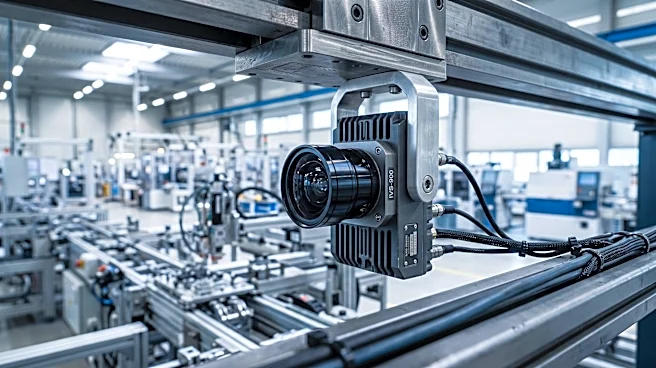
ProPhotonix, an Exaktera brand based in Salem, NH, USA, has launched COBRA Coaxial, a new beam-splitter attachment designed to provide on-axis illumination for COBRA line lights. This technology is specifically engineered for line scan and web inspection
systems. Traditional angled illumination often struggles with shiny or reflective surfaces, as it can create directional shadows that obscure critical details like scratches, engravings, and recessed features. The COBRA Coaxial unit addresses this by aligning the illumination directly with the camera’s optical axis, producing a bright and uniform field on flat specular surfaces. This alignment significantly enhances the contrast of surface features, making it easier to detect small defects or flaws on materials such as polished semiconductor wafers, glass, and metal sheets. The solution also benefits inspections in confined spaces or for recessed features where light needs to travel in a direct path.
Why It's Important?
This innovation is crucial for industries heavily reliant on precise surface inspection, particularly in manufacturing sectors dealing with highly reflective materials. The ability to accurately detect minute defects on surfaces like semiconductor wafers, glass, and metal sheets directly impacts product quality, yield rates, and overall manufacturing efficiency. For instance, in semiconductor manufacturing, even microscopic flaws can lead to device failure, making advanced inspection capabilities indispensable. By improving defect visibility, ProPhotonix's beam-splitter can help U.S. manufacturers reduce waste, enhance quality control, and potentially accelerate production cycles. This technology is particularly vital as automated inspection and AI continue to advance, as the quality of the initial image capture remains paramount for effective analysis. The solution offers a competitive edge for companies striving for higher precision and reliability in their production processes.
What's Next?
The introduction of the COBRA Coaxial beam-splitter is expected to be adopted by manufacturers in various high-precision industries, including electronics, automotive, and medical devices, where the inspection of reflective components is critical. Machine vision engineers will likely integrate this technology into existing or new inspection systems to overcome current limitations with specular surfaces. Future developments in illumination technology, as suggested by ProPhotonix's global product manager Matthew Branch, will likely focus on information interpretation, processing speed, and potentially AI-driven adjustments of lighting conditions before image acquisition. This suggests a trend towards more intelligent and adaptive lighting solutions that can further optimize automated inspection processes and enhance the capabilities of AI in defect detection.
Beyond the Headlines
The advancement in machine vision lighting, exemplified by the COBRA Coaxial, highlights a broader trend in industrial automation: the continuous refinement of foundational technologies to unlock new levels of precision and efficiency. While AI and advanced algorithms often capture headlines, the underlying hardware, such as specialized lighting, remains a critical enabler. This development underscores the ethical imperative in manufacturing to ensure product quality and safety, especially in sectors like medical devices or aerospace where defects can have severe consequences. Furthermore, the ability to inspect materials with greater accuracy can contribute to sustainability efforts by reducing material waste and improving resource utilization. The ongoing evolution of illumination technology, in conjunction with AI, points towards a future where automated inspection systems are not only faster but also more discerning and adaptable to complex manufacturing challenges.