



What's Happening?
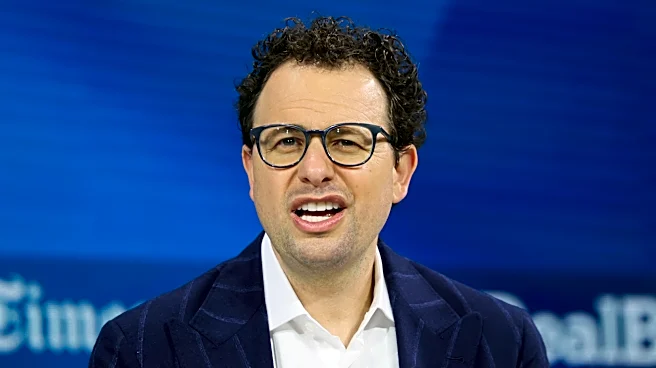
Jack Clark, co-founder of the artificial intelligence company Anthropic, has pledged to donate 80% of his personal equity in the company to charitable causes following its Nasdaq flotation. This commitment comes after Anthropic's IPO, which saw its shares
close at $97.17 on November 19, valuing the company at $1.8 trillion on a fully diluted basis. Forbes reports that Clark's net worth surged from $14.2 billion to an estimated $23.3 billion as a result. While the pledge is significant, Anthropic's prospectus notes that it is revocable and not legally binding. Clark, a former technology journalist for The Register and Bloomberg, co-founded Anthropic in 2021 after working at OpenAI since 2016. The company has also committed 5% of its shares to a new Anthropic Public Benefit Fund, an LLC, subject to stockholder approval, with Clark expected to be one of its first managers.
Why It's Important?
This development is significant for several reasons, particularly within the burgeoning AI industry and the broader philanthropic landscape. The substantial pledge from a key figure in a major AI company highlights a growing trend among tech leaders to address societal impacts and wealth distribution. While the revocable nature of the pledge raises questions about its long-term certainty, it nonetheless signals an intent to direct a considerable portion of new AI-generated wealth towards public good. The establishment of the Anthropic Public Benefit Fund, an LLC rather than a traditional charity, also introduces a new model for corporate philanthropy, potentially offering more flexibility in how funds are deployed but also less public disclosure. This could influence how other tech companies structure their social impact initiatives, impacting the flow of philanthropic capital and the types of causes that receive funding. The focus on AI's societal effects, jobs, and security through The Anthropic Institute, led by Clark, underscores the increasing awareness within the AI sector of its profound implications.
What's Next?
In the coming months, Anthropic is expected to provide more details on the structure and governance of its Public Benefit Fund. This will be crucial for understanding how the committed 5% of shares will be utilized and how the fund will operate as an LLC. Stakeholders, including nonprofit leaders and philanthropic organizations, will likely scrutinize these details, particularly regarding transparency and accountability, given the concerns already raised about the vague language surrounding the pledges. The effectiveness of Clark's 80% equity pledge will depend on whether it is ultimately honored and how the funds are distributed. Furthermore, The Anthropic Institute, under Clark's leadership, will continue its work in publishing evidence on AI's impact on jobs, security, and society, potentially influencing public policy and research directions in the AI domain. The company's commitment of $200 million to research on AI's economic effects could also be expanded upon by the new fund.
Beyond the Headlines
The revocable nature of Jack Clark's 80% equity pledge, as noted in Anthropic's prospectus, introduces a complex ethical dimension. While the intent to donate a significant portion of wealth is commendable, the lack of a legally binding commitment could lead to uncertainty and potential criticism if the pledge is not fully realized. This situation highlights a broader discussion within the tech industry about the responsibility of founders and executives to address the societal implications of their innovations and the wealth they generate. The choice of an LLC for the Public Benefit Fund, rather than a traditional charitable organization, also raises questions about transparency and public oversight. While an LLC might offer greater flexibility, it typically lacks the same level of public disclosure as a registered charity, which could lead to concerns about accountability. This development could spark further debate on the optimal structures for philanthropic endeavors by tech giants, balancing impact with transparency and public trust.