







What's Happening?
Blockstream CEO Adam Back has predicted that Bitcoin could reach $1 million by late 2028, an ambitious target significantly higher than its current price. This forecast is tied to Bitcoin's next halving event, expected in spring 2028, which reduces the
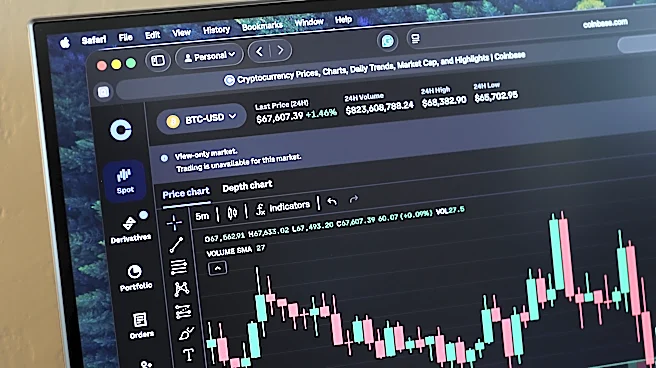
rewards for miners. Back suggests that rising prices will attract more investors, creating a positive feedback loop, and notes that miners are selling fewer coins as some divert resources to artificial intelligence activities. He believes Bitcoin's market value could eventually rival that of gold. Currently, Bitcoin is trading significantly below its all-time high, and its value has decreased over the past year. Achieving Back's $1 million target would imply a market value of approximately $20.11 trillion, a substantial increase from its current $1.43 trillion.
Why It's Important?
This prediction holds significant importance for the U.S. financial landscape and investment community. A surge in Bitcoin's value to $1 million would represent a massive shift in asset allocation and could challenge traditional investment paradigms. If Bitcoin were to reach a market value comparable to gold, it would likely attract substantial institutional and retail investment, potentially diverting capital from other asset classes. The stalled progress of the Clarity Act, a proposed bill to regulate crypto markets, highlights the regulatory uncertainty that could impede Bitcoin's growth. Without clear federal policies, new demand for Bitcoin in the U.S. might be limited, impacting its ability to reach such high valuations. The performance of spot Bitcoin ETFs, which have recently seen outflows despite initial popularity, also indicates a fluctuating investor sentiment that will be crucial for Bitcoin's future trajectory.
What's Next?
The trajectory of Bitcoin towards Adam Back's $1 million prediction by late 2028 hinges on several critical factors. The upcoming halving event in 2028 is anticipated to reduce supply, which historically has been a catalyst for price increases. However, significant inflows into spot Bitcoin ETFs are necessary to generate the demand required for such a dramatic price surge. The regulatory environment in the U.S. will also play a crucial role; the stalled Clarity Act needs to progress to provide clear guidelines for crypto markets, which could encourage broader adoption and investment. Without regulatory clarity, new demand for Bitcoin may remain constrained. Investors will be closely watching the performance of Bitcoin ETFs and legislative developments to gauge the likelihood of Back's ambitious forecast.
Beyond the Headlines
The aspiration for Bitcoin to reach a $1 million valuation by 2028 extends beyond mere price speculation, touching upon deeper economic and technological shifts. If Bitcoin were to achieve a market capitalization comparable to gold, it would signify a profound re-evaluation of digital assets as a store of value and a hedge against traditional financial systems. This could accelerate the integration of cryptocurrency into mainstream finance, prompting further innovation in blockchain technology and decentralized finance. However, such a dramatic increase also raises questions about market stability, potential bubbles, and the environmental impact of increased mining activities. The ongoing debate about Bitcoin's intrinsic value versus its speculative nature would intensify, potentially leading to more robust regulatory frameworks and a redefinition of monetary policy in the digital age.