



What's Happening?
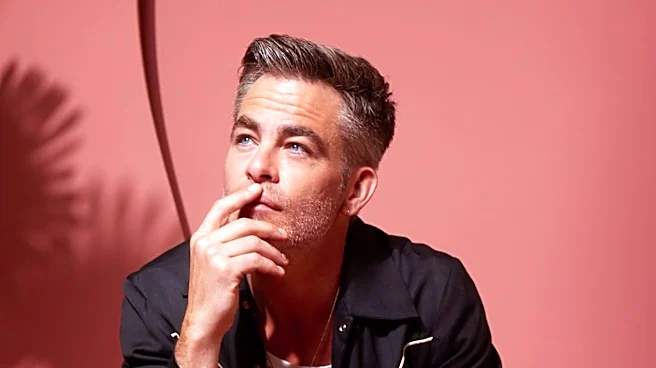
Chris Pine, a prominent Hollywood actor born on August 26, 1980, in Los Angeles, has established a significant career in film and television. Hailing from an acting family, with his father Robert Pine, mother Gwynne Gilford, and grandmother Anne Gwynne all
having acting backgrounds, Pine initially pursued theater after graduating with an English degree from Berkeley. His early television appearances included roles in 'ER,' 'The Guardian,' and 'CSI: Miami' in 2003. He gained early film recognition in 2004 as Nicholas Devereaux in 'The Princess Diaries 2' and later starred alongside Lindsay Lohan in the 2006 romantic comedy 'Just My Luck.' A pivotal moment in his career was securing the role of James T. Kirk in the 2009 film 'Star Trek,' a role he reprised in 'Star Trek Into Darkness' (2013) and 'Star Trek Beyond' (2016). During this period, he also appeared in the action film 'Unstoppable' with Denzel Washington and took on the lead in 'Jack Ryan: Shadow Recruit.' Pine received critical acclaim for his theatrical performance in 'The Lieutenant of Inishmore,' earning a Los Angeles Drama Critics Circle Award. In 2016, he delivered a highly praised performance in the crime drama 'Hell or High Water' alongside Ben Foster and Jeff Bridges. The same year, he was nominated for a Primetime Emmy for his voice work in the animated series 'SuperMansion.' He further expanded his filmography with roles as Steve Trevor in 'Wonder Woman' (2017) and its sequel 'Wonder Woman 1984' (2020). Pine also portrayed Scottish King Robert Bruce in 'Outlaw King' (2018) and voiced a version of Spider-Man in 'Spider-Man: Into the Spider-Verse' (2018). More recently, he appeared in 'Don't Worry Darling' (2022) and 'Dungeons & Dragons: Honor Among Thieves' (2023). Pine made his directorial debut with the comedy 'Poolman,' in which he also starred, though the film received negative reviews after its festival premiere. In 2014, he faced legal issues in New Zealand, being arrested for driving under the influence during the filming of 'Z for Zachariah,' pleading guilty and receiving a six-month driving ban and a fine.
Why It's Important?
Chris Pine's career trajectory is important as it showcases the evolution of a contemporary Hollywood actor navigating both blockbuster franchises and critically acclaimed independent projects. His success in the 'Star Trek' franchise solidified his status as a leading man, demonstrating his ability to carry major studio productions. Simultaneously, his commitment to diverse roles, such as his award-winning stage performance and his role in 'Hell or High Water,' highlights his versatility and dedication to craft beyond commercial appeal. This balance allows him to maintain relevance across different segments of the film industry, appealing to both mainstream audiences and critics. His foray into directing with 'Poolman,' despite its reception, signifies a common ambition among established actors to expand their creative control and influence within the industry. This move, whether successful or not, contributes to the broader trend of actors transitioning into directorial roles, shaping the future of filmmaking. Furthermore, his personal legal issues, while a setback, underscore the public scrutiny faced by high-profile individuals and the impact such events can have on public perception, even for established stars. His career serves as a case study for aspiring actors and industry observers on the multifaceted demands and opportunities within the entertainment landscape.
What's Next?
Following his recent film appearances and directorial debut, Chris Pine is likely to continue balancing his acting career with potential future directing projects. The reception of 'Poolman' may influence his immediate directorial endeavors, potentially leading him to take a more cautious approach or to seek different types of projects. As an established actor with a strong track record in both action and dramatic roles, he will likely remain a sought-after talent for various film and television productions. His involvement in major franchises like 'Star Trek' and 'Wonder Woman' suggests a continued presence in high-profile projects, though specific future installments are not detailed in the source. Pine's ability to attract diverse roles, from voice acting to period dramas, indicates that his career will probably continue to diversify. Industry observers will be watching to see if he pursues another directorial opportunity and how he chooses to further develop his creative footprint in Hollywood. His personal life, including his current relationship, may also remain a subject of public interest, though his professional choices will primarily define his next steps in the entertainment industry.
Beyond the Headlines
Beyond the immediate news of Chris Pine's career milestones, his journey reflects broader shifts in the entertainment industry, particularly the increasing fluidity between acting and directing roles. The trend of established actors venturing behind the camera, as Pine has done, speaks to a desire for greater creative control and a more holistic engagement with storytelling. This can lead to more actor-driven projects and potentially new narrative approaches in Hollywood. His success in both large-scale franchises and smaller, critically acclaimed films also highlights the evolving business model of studios, which often rely on recognizable stars to anchor diverse portfolios of content. The challenges he faced with his directorial debut, 'Poolman,' underscore the inherent risks and difficulties in transitioning to directing, even for seasoned professionals. This serves as a reminder that success in one area of filmmaking does not automatically guarantee it in another. Furthermore, the public's reaction to his legal incident in New Zealand, while not extensively detailed, points to the constant scrutiny and moral expectations placed on public figures, demonstrating how personal conduct can intersect with professional reputation in the digital age. His career, therefore, offers insights into the artistic ambitions, commercial pressures, and public responsibilities that define modern celebrity.