








What's Happening?
A new index from the National Association of Realtors (NAR) indicates an increasing demand for commercial real estate in numerous U.S. markets. South Carolina leads all states in future potential demand for commercial real estate. The NAR's index evaluates
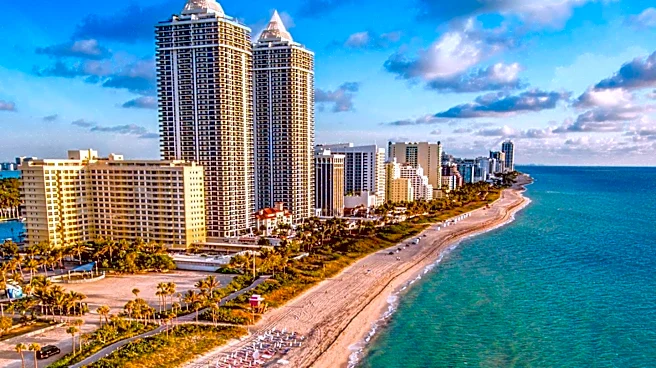
over 300 metropolitan markets, analyzing office, industrial, retail, and multifamily sectors, and incorporates economic conditions within each region, as reported by CNBC. The data used for these rankings includes government figures from the Bureau of Labor Statistics and the Census Bureau, focusing on population and movement. Specifically, the office sector's growth is linked to professional and business services employment, while industrial demand considers manufacturing, transportation, and warehousing employment growth. Retail trade, leisure, and hospitality employment are factors for retail, and population growth and net migration (domestic and international) inform the multifamily sector. Nadia Evangelou, principal economist and director of real estate research at NAR, emphasized that the index highlights areas where momentum and demand are building. Raleigh, North Carolina, is noted as the only major market stronger now than in 2022, which was the peak of the pandemic migration boom. Conversely, previously 'superhot' markets like Austin, Texas, and Miami and Naples, Florida, have seen declines over the past four years. St. George, Utah, is identified as the strongest metropolitan market due to its office employment growth, strong population growth, in-migration, and above-average industrial demand.
Why It's Important?
This surge in commercial real estate demand across various U.S. markets signals a significant shift in investment opportunities and regional economic development. The NAR's index provides crucial insights for investors, guiding them toward areas with strong underlying economic fundamentals and growth potential. The decline of previously 'superhot' markets and the rise of smaller and mid-sized markets, as highlighted by Nadia Evangelou, suggest a decentralization of commercial real estate investment. This trend could lead to more balanced economic growth across different regions of the U.S., potentially fostering job creation and infrastructure development in areas that were not traditionally primary investment hubs. For businesses, understanding these demand shifts is vital for strategic location planning, whether for office spaces, industrial facilities, retail outlets, or multifamily housing. The emphasis on employment growth in specific sectors (professional services, manufacturing, transportation, retail, hospitality) underscores the importance of local economic drivers in shaping real estate demand. This data can influence public policy decisions related to urban planning, zoning, and incentives for businesses, ultimately impacting local economies and the livelihoods of residents.
What's Next?
Investors and developers are likely to increasingly focus on the markets identified by the NAR index as having strong and growing commercial real estate demand. This could lead to increased investment and development activities in areas like South Carolina and St. George, Utah, potentially driving up property values and construction projects. Small and mid-sized markets, which Nadia Evangelou suggests offer some of the best opportunities, may experience a boom in commercial development. Conversely, markets that have seen declines, such as Austin, Miami, and Naples, may need to reassess their economic strategies to attract new investment or adapt to changing demand patterns. Local governments in these growing areas may face challenges and opportunities related to infrastructure development, urban planning, and managing population growth. The continued monitoring of employment trends and population shifts will be crucial for stakeholders to anticipate future demand and adjust their strategies accordingly. The NAR's ongoing data collection and analysis will remain a key resource for understanding these evolving dynamics in the U.S. commercial real estate sector.
Beyond the Headlines
The shifting landscape of commercial real estate demand, as revealed by the NAR index, points to deeper societal and economic transformations. The decline of major coastal markets and the rise of smaller, inland areas could reflect a long-term trend of population redistribution, possibly influenced by factors such as remote work, cost of living, and quality of life preferences. This decentralization could have profound implications for urban planning, leading to the development of new economic centers and potentially alleviating some of the pressures on historically overcrowded and expensive metropolitan areas. Furthermore, the specific drivers of demand, such as growth in professional services and manufacturing, highlight the evolving nature of the U.S. economy. The increased focus on industrial properties, for instance, could be linked to the expansion of e-commerce and logistics. This trend also raises questions about environmental sustainability, as new development in previously less-developed areas could impact natural resources and local ecosystems. The ethical considerations of equitable development and ensuring that growth benefits all segments of the population in these emerging markets will also become increasingly important.