







What's Happening?
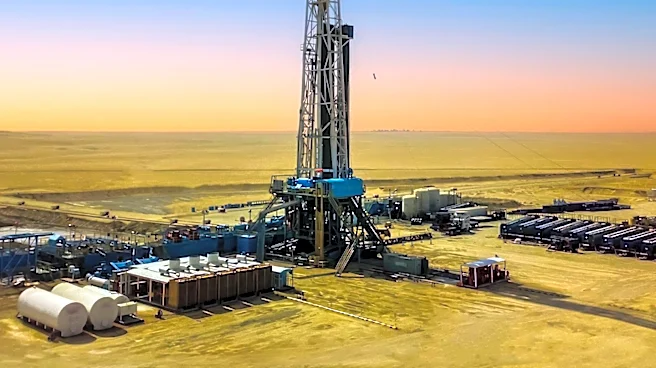
Argentina's Vaca Muerta shale formation, holding the world's fourth-largest shale oil and second-largest shale gas reserves, is experiencing a significant boom, with daily oil production now exceeding 850,000 barrels, up from 500,000 a decade ago. This
surge has led crude oil to surpass soy flour as the country's top export for the first time. President Javier Milei has championed Vaca Muerta as a potential solution to Argentina's chronic economic instability, betting heavily on the project to attract foreign investment and generate export dollars. The Neuquén province, home to Vaca Muerta, is seeing rapid development, with new infrastructure and job opportunities in the energy sector. However, this economic transformation is occurring alongside Milei's austerity measures, which have led to business closures and weakened domestic demand in other sectors, raising questions about the overall economic impact and job creation.
Why It's Important?
The Vaca Muerta boom represents a critical juncture for Argentina's economy, offering a potential pathway to stability and growth after decades of inflation and currency crises. The influx of dollars from energy exports could significantly alleviate the country's financial woes and reduce its reliance on traditional agricultural exports. For U.S. investors, the growing energy sector in Argentina, particularly with the support of figures like American billionaire Peter Thiel, presents new opportunities for investment in a region with vast untapped resources. However, the focus on energy and mining, which are less labor-intensive, raises concerns about job displacement in other sectors like manufacturing and retail, potentially exacerbating social inequalities. The environmental implications of increased fracking and the long-term commitment to fossil fuels also present a complex challenge, especially as global efforts shift towards renewable energy sources.
What's Next?
President Milei's administration is expected to continue prioritizing the energy sector, offering investment tax breaks and facilitating fuel exports to further capitalize on Vaca Muerta's potential. The ongoing development of vital new pipelines will be crucial for expanding export capacity. While the energy sector is thriving, the government faces the challenge of mitigating the negative impacts of austerity measures on other parts of the economy and ensuring that the benefits of the oil boom are more broadly distributed. The debate over job creation and the environmental consequences of fracking will likely intensify, with indigenous communities and environmental groups continuing to voice concerns. The long-term success of Vaca Muerta in transforming Argentina's economy will depend on the government's ability to balance economic growth with social equity and environmental sustainability, as well as its capacity to attract sustained foreign investment.
Beyond the Headlines
The Vaca Muerta phenomenon highlights a deeper tension within Argentina's economic strategy: the pursuit of rapid growth through resource extraction versus the need for diversified, inclusive development. While the energy boom offers a lifeline, it also risks creating a dual economy where the thriving energy sector coexists with struggling traditional industries. This disparity could lead to increased social friction and regional imbalances, as seen in the rapid urbanization and strain on resources in areas like Añelo. The reliance on foreign investment and advanced technology for extraction also raises questions about national sovereignty over natural resources and the distribution of wealth. Furthermore, committing heavily to fossil fuels in an era of climate change raises ethical and long-term economic questions about Argentina's energy future and its role in global environmental efforts. The 'Vaca Muerta fever' encapsulates both the immense hope and the significant challenges facing Argentina's path to prosperity.