






What's Happening?
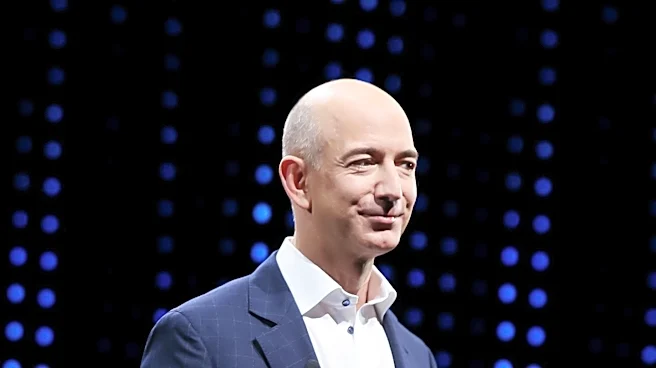
Amazon founder Jeff Bezos predicts that advancements in artificial intelligence (AI) could lead to a future where families can thrive on a single income or workers can support a family on a three-day work week. Speaking on Fox News, Bezos suggested that AI-driven
productivity gains would create a labor shortage, with employers competing for workers who could afford to work less. This optimistic outlook contrasts with warnings from other tech leaders, such as Anthropic CEO Dario Amodei, who forecasts that AI could eliminate half of all entry-level white-collar jobs within five years and push unemployment to 10% to 20%. Microsoft co-founder Bill Gates also cautioned that the shift to AI would be one of the most turbulent times in human history, with world leaders unprepared for its risks.
Why It's Important?
Jeff Bezos's prediction about AI's potential to enable single-income households or shorter workweeks highlights a significant debate about the future of work and economic structures in the U.S. If realized, such a shift could reverse a half-century trend of increasing two-income households, profoundly impacting family dynamics, consumer spending, and social policies. However, the contrasting views from other tech leaders, who foresee job displacement and economic turbulence, underscore the uncertainty and potential risks associated with widespread AI adoption. The outcome will depend on whether productivity gains translate into higher wages and reduced working hours for employees or primarily into increased profits and reduced headcounts for corporations. This discussion is crucial for policymakers, businesses, and individuals as they prepare for the transformative effects of AI on the American economy and society.
What's Next?
The divergence in predictions from tech leaders like Jeff Bezos, Dario Amodei, and Bill Gates indicates an ongoing and critical debate about the societal impact of AI. In the near term, businesses and policymakers will need to address potential job displacement and the need for workforce retraining, as suggested by Amodei and Gates. Bezos's investment in Project Prometheus, an AI startup focused on engineering and manufacturing, suggests a push towards making AI tools more accessible, potentially accelerating productivity gains. The coming years will likely see increased investment in AI research and development, alongside growing discussions about ethical AI deployment, labor market adjustments, and the role of government in managing the transition. The key question remains whether the benefits of AI will be broadly distributed or concentrated, shaping economic inequality and social stability.
Beyond the Headlines
The debate surrounding AI's impact on the workforce extends beyond mere job numbers to fundamental questions about economic equity and the distribution of wealth. If AI primarily boosts corporate profits without commensurate gains for workers, it could exacerbate existing inequalities, challenging the notion of a 'one-paycheck' household. The historical parallel to the iPhone's initial skepticism, as noted in the source, suggests that revolutionary technologies often face initial misjudgments. However, AI's potential to automate cognitive tasks presents a different scale of disruption. This situation calls for a re-evaluation of social safety nets, education systems, and labor policies to ensure a just transition. The ethical implications of AI, including bias, privacy, and control, will also become increasingly prominent, requiring careful consideration from both technological developers and societal leaders.