





What's Happening?
Starfighters Space (FJET) is strategically positioning its fleet of seven modified F-104 Starfighters to capitalize on the expanding commercial space market, particularly in air-launch services and aerospace testing. These iconic Cold War aircraft, capable
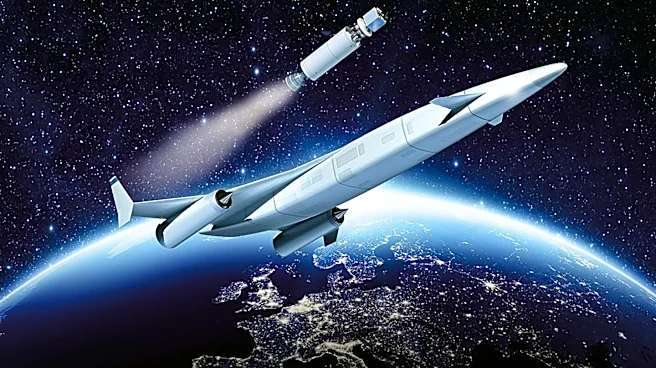
of sustained Mach 2 flight, are based at NASA's Kennedy Space Center in Florida and Midland International Air & Space Port in Texas. The company utilizes these F-104s as 'flying laboratories' for customers like GE Aerospace, Lockheed Martin, and the U.S. Air Force Research Laboratory, enabling them to evaluate hypersonic components, advanced materials, and propulsion systems under actual supersonic conditions. The core of their strategy is the STARLAUNCH program, which envisions the F-104 serving as a reusable airborne first stage. This approach aims to offer more responsive and cost-effective delivery of small payloads to low Earth orbit by releasing rockets at approximately 45,000 feet and Mach 2, contrasting with traditional ground-based launches.
Why It's Important?
This development is significant for the U.S. aerospace industry as it addresses the growing demand for responsive space access and hypersonic testing, driven by U.S. defense priorities. The small-satellite launch market is projected to exceed $69 billion by 2030, creating a substantial opportunity for innovative launch solutions like Starfighters Space's air-launch system. By offering a potentially more cost-effective and flexible alternative to ground-based launches, the company could attract a niche but critical segment of the market. Furthermore, its testing services contribute to the advancement of hypersonic technology, a key area of focus for national security. The success of Starfighters Space could also stimulate further innovation in reusable space systems and microgravity research, fostering competition and driving down costs across the commercial space sector.
What's Next?
Starfighters Space has several key milestones on the horizon that will influence its trajectory. The company has completed wind-tunnel and separation testing for STARLAUNCH 1 with GE Aerospace. A captive-carry flight with Blackstar Orbital's reusable 'SpaceDrone' is planned for Q4 FY2026, aiming for a high-altitude supersonic release. Additionally, a suborbital launch with Vaya Space is scheduled for 2027. These events are crucial for validating the air-launch approach and transitioning from demonstration to commercial revenue. The company also needs to address ongoing financial challenges, as it remains cash-flow negative and may require further capital. Regulatory shifts, such as potential easing of supersonic flight rules, could also broaden its market opportunities. The company's ability to convert its supersonic capability into sustained, scalable revenue from test services and launch contracts will be critical for its future.
Beyond the Headlines
The long-term implications of Starfighters Space's endeavors extend to the broader evolution of space access and defense capabilities. The emphasis on reusable airborne first stages could pave the way for more sustainable and environmentally friendly launch practices, reducing the carbon footprint associated with space missions. Ethically, the dual-use nature of the F-104s for both commercial launch and defense-related hypersonic testing raises questions about the blurring lines between civilian and military space activities. The company's success could also influence public policy regarding federal defense and space budgets, potentially leading to increased investment in similar innovative aerospace ventures. Culturally, the re-purposing of Cold War-era aircraft for cutting-edge space applications represents a fascinating blend of historical technology and future-oriented innovation, potentially inspiring new approaches to resource utilization in the aerospace sector.