




What's Happening?
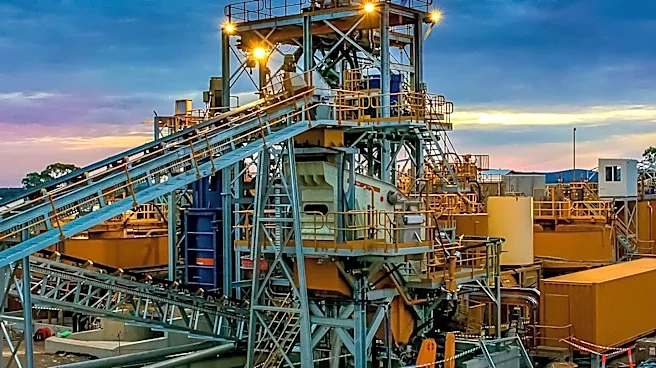
Allied Gold has announced that its Kurmuk Mine in Ethiopia is now connected to the national grid. This milestone follows the processing of the first ore through the crushing circuit, with approximately 1,000,000 tonnes of ore stockpiled to support the ramp-up
towards commercial production. The connection is facilitated by an 88-kilometer power line constructed by Ethiopian Electric Power, backed by a 20-year power purchase agreement at an estimated US$0.04 per kilowatt-hour. This development is expected to position Kurmuk as a low-cost contributor to Allied Gold's portfolio, aligning with the company's strategy to achieve lower unit costs and more stable cash generation through operational upgrades and new projects.
Why It's Important?
The grid connection is a significant operational step for Allied Gold, directly supporting its investment thesis of becoming a more stable and profitable gold producer. Access to low-cost grid power, secured through a long-term agreement, provides predictable energy costs, which is crucial for a business that has historically faced high all-in sustaining costs. This stability in power supply and cost is vital for the mine's ramp-up and eventual commercial operations, reducing a major variable expense. For shareholders, this development signals progress in the company's broader expansion program, with Kurmuk and the Sadiola expansion being central to Allied Gold's growth narrative. The successful commissioning and consistent commercial output from Kurmuk could significantly impact the company's revenue and earnings forecasts, which project substantial growth by 2029.
What's Next?
The immediate focus for Allied Gold will be on the transition of Kurmuk from commissioning into consistent, commercial output. Key upcoming catalysts include the handover of the crushing circuit to operations, ore feed into grinding, and the first gold pour. Following these steps, the company will need to demonstrate that Kurmuk can operate reliably at its planned throughput and grade. Any delays, cost overruns, or underperformance in grade at this core asset could significantly impact the company's trajectory. Analysts are currently working with revenue projections of $3.5 billion and earnings of $1.1 billion by 2029, implying substantial growth from current losses. The successful execution of these next stages will be critical in shaping how the market views Allied Gold's future performance and its potential to achieve these financial targets.
Beyond the Headlines
This development in Ethiopia highlights the growing trend of mining companies leveraging national infrastructure to reduce operational costs and improve sustainability. The long-term power purchase agreement not only provides cost predictability but also potentially reduces the mine's carbon footprint compared to reliance on diesel generators. This could enhance Allied Gold's environmental, social, and governance (ESG) profile, which is increasingly important for investors. Furthermore, the project's success could attract more foreign direct investment into Ethiopia's mining sector, contributing to the country's economic development and infrastructure expansion. The integration of such large-scale industrial projects with national grids can also spur broader economic benefits, including job creation and local community development, provided that the benefits are equitably distributed and environmental impacts are managed responsibly. The case of Kurmuk demonstrates how strategic infrastructure partnerships can de-risk large-scale mining ventures.