



What's Happening?
The U.S. Department of Homeland Security (DHS) has approved a third extension of the Jones Act waiver, originally issued to the U.S. Department of War (DOW) on March 17, 2026. This extension, announced by U.S. Customs and Border Protection (CBP) on November
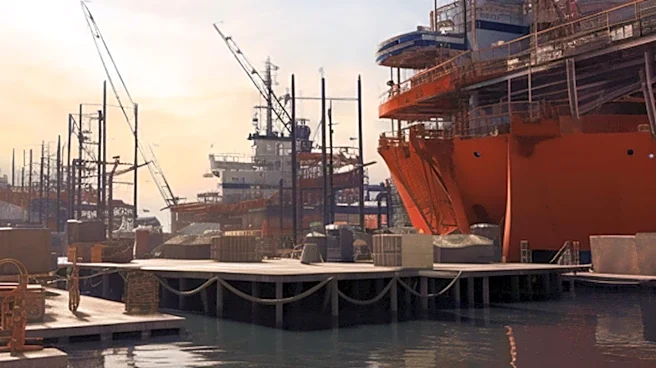
13, 2026, through Cargo Systems Messaging Service (CSMS) No. 70435180, allows certain qualifying goods to be transported between U.S. ports on vessels not classified as coastwise-qualified U.S. vessels under the Merchant Marine Act of 1920. The waiver is effective for an additional 90-day period, commencing November 16, 2026, at 12 a.m. ET, with a loading deadline of February 14, 2027, at 11:59 p.m. ET. The list of covered products remains unchanged from the August 17, 2026, list, encompassing 237 Harmonized Tariff Schedule (HTS) codes, primarily focusing on petroleum products, liquefied natural gas, and various chemical compounds and fertilizers. The pre-voyage authorization process, which includes a market survey by the U.S. Maritime Administration (MARAD) and a determination by DOW, also remains in effect.
Why It's Important?
This third extension of the Jones Act waiver is significant for U.S. industries involved in the transportation of specific commodities, particularly those reliant on foreign-flagged vessels for domestic shipping. The continuity of the waiver, with its established product scope and authorization process, provides a degree of predictability for companies that have adapted to its requirements. Industries dealing with petroleum products, liquefied natural gas, and certain chemicals will continue to benefit from the flexibility in shipping options, potentially mitigating logistical challenges and costs associated with relying solely on coastwise-qualified U.S. vessels. The rigorous pre-voyage authorization process, which demands a national defense justification for each voyage, underscores the government's scrutiny of these waivers. This process ensures that the exceptions to the Jones Act are granted only when deemed essential for national defense interests, balancing economic needs with national security concerns. Companies that fail to adhere to the detailed documentation and justification requirements risk denial of the waiver, impacting their supply chains and operational efficiency.
What's Next?
Companies utilizing the Jones Act waiver must continue to meticulously confirm Harmonized Tariff Schedule (HTS) classifications against the current list and factor in lead times for the MARAD market survey and DOW determination. They are also required to prepare specific national defense justifications for each voyage and maintain robust documentation for CBP notification and post-voyage reporting. The current extension is set to expire on February 14, 2027. Stakeholders should closely monitor for any further extensions or modifications to the waiver ahead of this deadline. The ongoing need for such waivers suggests potential long-term discussions regarding the capacity and availability of coastwise-qualified U.S. vessels to meet domestic shipping demands, particularly for critical commodities. Future decisions will likely depend on evolving national defense requirements and the state of the U.S. maritime industry.
Beyond the Headlines
The repeated extensions of the Jones Act waiver highlight a persistent tension between the protective intent of the Merchant Marine Act of 1920 and contemporary logistical and economic realities. While the Jones Act aims to support the U.S. maritime industry by requiring domestic shipping to be conducted by U.S.-flagged, U.S.-built, U.S.-crewed, and U.S.-owned vessels, the necessity of these waivers suggests that the existing U.S. fleet may not always possess the capacity or specialized capabilities to meet all domestic transportation needs, especially for certain bulk commodities. This situation raises broader questions about the long-term health and competitiveness of the U.S. maritime sector, the adequacy of its infrastructure, and its ability to adapt to modern trade demands. The waivers, while providing short-term relief, could also spark debates about potential investments in U.S. shipbuilding and crew training to reduce reliance on such exceptions in the future, thereby strengthening national economic and security interests.