






What's Happening?
Bank of America (BofA) has increased its projected compound annual growth rate (CAGR) for the U.S. semiconductor industry to 18% through 2030, up from its previous estimate of 14%. This upward revision is primarily driven by accelerated spending on artificial
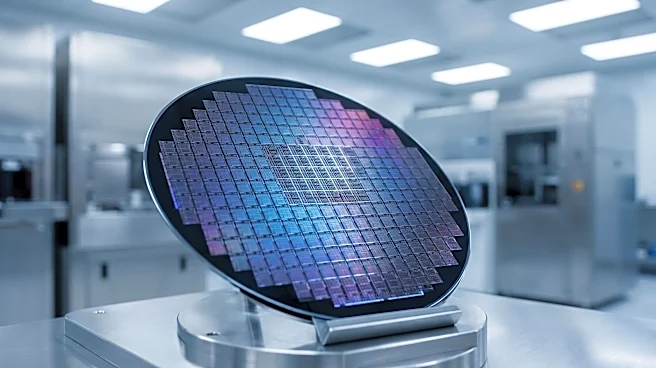
intelligence (AI) infrastructure. BofA anticipates the total market opportunity for the sector to reach $3.2 trillion by the end of the decade, with memory chips and data center components being significant contributors to this surge. The bank believes the industry could double its current $1.7 trillion market size in just four years, a notable acceleration compared to the five decades it took to first exceed $1 trillion. Within this growth, BofA is particularly optimistic about wafer fab equipment (WFE), the machinery used to process silicon wafers. The bank has raised its 2026 WFE spending forecast to $156 billion and expects it to reach $210 billion in 2027, largely fueled by the increasing demand for DRAM (Dynamic Random-Access Memory) driven by the AI data center boom. Companies like Applied Materials, Lam Research Corporation, and KLA Corporation are identified as well-positioned to benefit from this trend.
Why It's Important?
This revised forecast from Bank of America underscores the profound impact of AI on the U.S. semiconductor industry and the broader technology landscape. The projected rapid expansion signifies a massive economic opportunity, attracting significant investment and fostering innovation within the sector. The emphasis on memory chips and data center components highlights the critical infrastructure required to support advanced AI workloads, indicating a shift in manufacturing priorities and technological development. For U.S. industries, this means increased demand for specialized hardware, potentially leading to job creation, research and development investments, and a strengthening of the domestic technology supply chain. Companies involved in WFE, such as Applied Materials, Lam Research, and KLA, stand to gain substantially from the increased capital expenditure by chipmakers. The accelerated growth trajectory also suggests a competitive advantage for U.S. companies at the forefront of AI chip development and manufacturing, potentially solidifying the nation's leadership in this crucial technological domain. Conversely, businesses that fail to adapt to the escalating demand for AI-compatible infrastructure may face competitive disadvantages.
What's Next?
The increased demand for AI-driven semiconductor products is expected to lead to continued investment in manufacturing capacity and technological advancements. Chipmakers will likely focus on developing more sophisticated memory architectures, advanced packaging solutions, and specialized processors to meet the evolving needs of AI workloads. This will translate into sustained demand for deposition, etch, and treatment tools from companies like Applied Materials, and advanced process control tools from KLA Corporation, as manufacturing complexity increases. The industry can anticipate further consolidation and strategic partnerships as companies vie for market share and technological leadership in the AI chip space. Furthermore, the robust growth in the semiconductor sector is likely to attract more venture capital and private equity investments, fueling further innovation and expansion. The focus on DRAM and data center components suggests that companies in these segments will continue to experience strong revenue growth and profitability, potentially leading to higher stock valuations and increased shareholder returns. The long-term capacity forecasts from customers indicate improved demand visibility, which will enable semiconductor equipment manufacturers to plan their operations and investments more effectively.
Beyond the Headlines
The surging demand for AI chips and the subsequent growth in the semiconductor industry have broader implications beyond immediate economic gains. This trend highlights the increasing reliance of modern economies on advanced computing power, making the semiconductor supply chain a critical component of national security and economic stability. The push for more sophisticated chip architectures and manufacturing processes could also accelerate the development of new materials and engineering techniques, fostering innovation across various scientific and industrial fields. Ethical considerations surrounding the development and deployment of AI, such as data privacy, algorithmic bias, and the potential impact on employment, will become more prominent as AI technology becomes more pervasive. The rapid expansion of data centers, a key driver of chip demand, also raises environmental concerns regarding energy consumption and carbon footprint, prompting a need for more sustainable computing solutions. Ultimately, the trajectory of the semiconductor industry, heavily influenced by AI, will shape the future of technology, economy, and society, necessitating careful consideration of its multifaceted impacts.