



What's Happening?
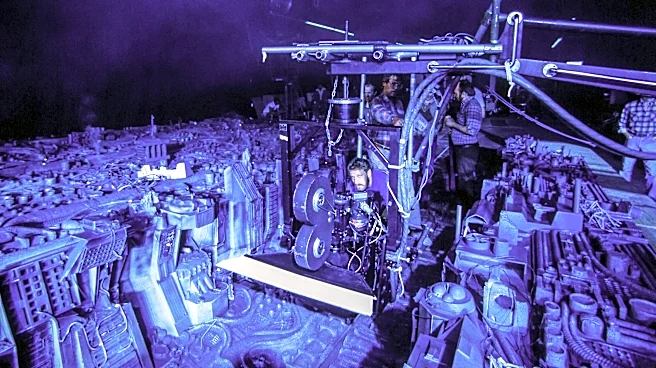
Industrial Light & Magic (ILM) developed a specialized motion-control dolly system called VistaGlide for 'Back to the Future Part II' to enable complex scenes where Michael J. Fox played multiple characters simultaneously, particularly during moving camera
shots. Cinematographer Dean Cundey recounted on ILM's 'Lighter Darker' podcast how this technology was crucial for a scene where Fox, playing Marty Sr., Marty Jr., and Marlene McFly, had to hand himself a glass of water. Unlike traditional stationary split-screen techniques, director Robert Zemeckis wanted the camera to move, requiring precise repetition of camera movements. VistaGlide allowed operators to record a camera move, review it, and repeat it exactly for subsequent takes, ensuring that Fox's different performances could be seamlessly composited into a single, dynamic shot.
Why It's Important?
The development of the VistaGlide system by ILM represents a significant advancement in cinematic special effects, pushing the boundaries of what was technically possible in filmmaking at the time. This innovation allowed for more dynamic and immersive storytelling, moving beyond static split-screen effects to create fluid camera movements even when a single actor portrayed multiple characters in the same frame. This technological leap not only enhanced the visual realism of 'Back to the Future Part II' but also paved the way for future special effects techniques that rely on precise motion control and compositing. The ability to seamlessly integrate multiple performances from one actor in a moving shot became a benchmark for visual effects, influencing subsequent productions and contributing to the evolution of modern cinema.
Beyond the Headlines
The technical ingenuity behind the VistaGlide system highlights the continuous interplay between creative vision and technological innovation in the film industry. The seemingly simple act of handing a glass of water between different versions of Michael J. Fox required meticulous planning and execution, including the use of a physical marker on the table for exact placement. This level of detail underscores the often-unseen complexity behind cinematic illusions. Such innovations not only serve the immediate needs of a film but also contribute to a broader knowledge base in visual effects, inspiring new tools and methodologies. The story of VistaGlide is a testament to how specific creative challenges can drive significant technological breakthroughs that have lasting impacts on the art and craft of filmmaking.